Nissan’s rugged X-Trail has been fairly popular in South Africa and it has even been a finalist in the Cars.co.za Consumer Awards powered by WesBank on numerous occasions.
The X-Trail is known as the Rogue in the North American market and the latest version has now been revealed. It’s built on a modified version of Nissan’s CMF platform and perhaps the most striking feature of the updated X-Trail is the bold interpretation of Nissan’s V-Motion grille in thick-rimmed chrome. The smart-looking grille is further complemented with the slimmer split LED headlights. It’s definately more grown up and sophisticated in appearance. Where most new models grow in size over time, the latest X-Trail is actually more compact than before with its wheelbase reduced by 2.54 mm and length reduced by some 43.2 mm. What’s more, this latest X-Trail will is longer be offered in 7-seat guise.
As for the interior, the reduced exterior dimensions, however, translate into slight more leg and headroom than before. As for the driver’s cabin, material quality and fit and finish appears to have been improved upon and a new 8-inch infotainment touchscreen is standard with Apple CarPlay and Android Auto functionality while a larger 9-inch unit is optional. The instrument cluster is larger at 7-inches and high-spec Nissan X-Trail derivatives are offered with a 12.3-inch digital cockpit and a 10.8-inch head-up display. The top-spec X-Trail can also be had with tan, diamond-quilted aniline leather upholstery as well as nice-to-haves such as Nissan’s ProPilot Assist (with long-range radar and wide camera), wireless Apple CarPlay, a wireless charging pad and a 10-speaker Bose sound system.
As for the engine, a new 2.5-litre naturally-aspirated petrol engine with 135 kW and 245 Nm of torque is found under the Nissan X-Trail bonnet and is mated with a Continuously Variable Transmission (CVT).
Nissan South Africa confirmed that the all-new Nissan Qashqai will make its debut in South and sub-Saharan Africa later in 2021.
It’s coming! The all-new Nissan Qashqai, the third generation of the pioneering crossover.
And while South Africans may have to wait a little longer, Nissan South Africa confirmed that the all-new Qashqai will make its debut in South and sub-Saharan Africa.
NISSAN QASHQAI PROMISES TO BE A GAME-CHANGER
Showcasing the advanced technology available on the new Qashqai, the Premiere Edition will offer customers unprecedented convenience features which are normally found in upper automotive segments.
“As part of the Nissan Next Transformation Plan in our region, we are excited to welcome the new edition to the Qashqai family later this year. Fourteen years after creating the crossover segment, we are confident that this model will be a game-changer,” said Nissan South Africa marketing director Stefan Haasbroek,
“This pioneering model will be in South and Sub-Saharan Africa in the latter part of the 2021 Financial Year for both regions, respectively, and we are looking forward to a completely renewed design inside and out, innovative technologies and electrified power on our roads.”
INFOTAINMENT UPDATED
The central screen is a 9-inch TFT screen that houses Nissan’s upgraded infotainment system, while an additional 12-inch TFT configurable screen sits in front of the driver, replacing the traditional dials.
To complement the high-definition TFT screen, the driver will also benefit from a 10.8-inch Head-Up Display (HUD), the largest in the segment, offering speed, navigation directions and road information directly in the driver’s line of sight. Taking into account the two screens, and the head-up display – the driver has easy and convenient access to key information while driving.
FOCUS ON CONNECTIVITY
Additional convenience comes in the form of a wireless charging pad, allowing occupants to easily charge their smartphones. At 15w, the wireless charging unit is among the most powerful in the segment. And while the smartphone is charging wirelessly, suitably equipped iPhones can connect to the Qashqai via wireless Apple CarPlay®, allowing seamless usage of many of the phone’s apps.
Additional connectivity is available for all occupants, with a total of 4 USB charging ports, with 2 USB-A and 2 USB-C ports.
A lot of the technological updates on the new Qashqai work quietly in the background, acting as an extra pair of eyes.
DRIVER SUPPORT
The Premiere Edition Qashqai will be available with the newly upgraded ProPILOT with Navi-link, which brings greater driver support in a wider array of circumstances, for peace of mind in all driving scenarios.
At night, the driver will appreciate the LED matrix headlights that are equipped with advanced driving beam technology.
The headlights emit a strong, bright beam with a large range, giving excellent visibility. When an approaching vehicle is detected, the beam effectively changes shape to have the effect of putting the oncoming vehicle in a shadow, so the driver is not blinded, but the rest of the road remains clearly illuminated.
TWO-TONE COLOURS
The styling has always been at the heart of the success of the Nissan Qashqai, and the appeal of the Qashqai Premier Edition has been elevated thanks to the introduction of a palette of two-tone colour options for a more personalised choice. The following body colours are available with a striking black roof: New blue, pearl grey and pearl white, while the black body colour is available with a grey roof.
The Premiere Edition also features neatly integrated roof rails, which are finished in matt silver.
ATTENTION TO AESTHETICS
The additional aesthetic appeal comes in the form of new 18-inch diamond-cut alloy wheels, which complement the new Qashqai’s stance, which is more purposeful thanks to the longer wheelbase and sharp shoulder lines over the wheels.
Life-on-board is given an airy feel thanks to the panoramic roof, with a powered sliding blind to protect occupants on hot and sunny days.
The interior follows a classic format, with black cloth trim, black dashboard and centre console, which combine to give the interior an air of refinement and pedigree, while a grey roof trim prevents the overall ambience from being oppressive. The grey roof lining also reinforces the additional interior head, knee and shoulder space that has been generated thanks to the longer wheelbase and smart packaging of the CMF-C platform.
EFFICIENT MILD HYBRID TECHNOLOGY
The new Qashqai Premier Edition is powered by a highly evolved iteration of the 1.3-litre turbocharged petrol engine found on the current Qashqai. However, Nissan’s engineers have developed it to include mild hybrid technology which enhances its efficiency.
Thanks to the addition of a secondary Lithium-ion battery system, the new Qashqai offers extended idle stop, quicker restart and coasting stop (automatic only).
The system will even boost torque under acceleration, offering an additional 6Nm for up to 20 seconds.
The 1.3-litre engine in the Premiere Edition is available in two configurations: 103 kW with a six-speed manual gearbox or 116 kW coupled with Nissan’s advanced Xtronic gearbox, which is operated via the new, convenient gear selector on the centre console. Additionally, manual control of the Xtronic can be managed via paddles behind the steering wheel.
The new Nissan Almera Turbo is beginning to appear on roads around the world in increasing numbers as new owners take delivery of their cars. Apart from the fresh new styling and turbocharged powertrain, the new Almera is also packed with many safety technologies which can contribute to helping reduce road accidents. Keep reading or find out more about the current Nissan Almera, available in South Africa.
Nissan Safety Shield 360
These are the Nissan Safety Shield 360 technologies that work together to provide safety monitoring and intervening to prevent accidents when necessary. This follows the trend in the industry whereby driver assistance systems are being provided which use camera imagery as well as radar sensors to scan the road ahead. Additionally, there are sensors to scan the sides for vehicles in blind spots, and towards the rear to aid reversing.
Standard on all Almera Turbo variants is the Intelligent Forward Collision Warning (IFCW) and Intelligent Forward Emergency Braking (IFEB) systems. The IFCW, operational at speeds between 5 km/h and 80 km/h, monitors the road ahead and alerts the driver when the car is too close to a vehicle ahead or there is a risk of collision.
The alert is shown on the 7-inch Advanced Drive-Assist Display (ADAD), along with an audible alert. This means the driver should take steps such as decelerating or even braking to avoid the collision. However, if the driver does not take these actions, then the system will take over and activate the brakes automatically.
The early braking should prevent a collision or at least reduce the speed so that the severity is less, which can make repair costs less expensive. The brakes will remain locked for about 2 seconds after the car stops moving before being deactivated.
Alerting drivers behind
Incidentally, the Nissan Almera brake system has an Emergency Stop Signal function which can help to reduce rear-end collisions. If the brake pedal is pressed hard and suddenly, the hazard warning lights will come on automatically (besides the brake lights, of course). This will alert drivers behind that the car is decelerating very quickly under braking as they might not notice it right away. This will prompt them to also brake and slow down, and it could prevent the sort of multiple accidents on highways that we read about.
Watching the sides and rear
Other safety technologies available are the Blind Spot Warning (BSW) and Rear Cross-Traffic Alert (RCTA) systems. BSW is available from around 32 km/h and uses sensors to keep an eye on blind spot areas at approximately 3 metres x 3 metres towards the rear sides of the car. If the turn signal is activated and a vehicle is detected, the drive will be warned by sound as well as warning indicators on the ADAD and the relevant side mirror.
RCTA is a more recent safety system that is slowly appearing in cars. It is useful during reversing out of a parking bay when the driver’s view of either side might be blocked. The same rear radar sensors help to detect an approaching vehicle on either side and warn the driver with an audible alert and indicator on the side mirror where the vehicle is approaching from. This warning could help save an expensive accident!
Parking made easy
The Almera Turbo driver is also assisted by the Intelligent Around View Monitor (IAVM) with Intelligent Moving Object Detection (IMOD). This system (also offered in the X-Trail, Serena S-Hybrid and Navara) not only helps make parking easier but also watches out for moving objects nearby so that an accident does not occur.
The IAVM uses 4 tiny cameras installed on the bodywork and with the use of a computer program, the images are combined to create a simulated view of the car from above which shows all sides. It’s like having a drone overhead sending a video view to the display on the dashboard. The simulated image is detailed enough to show obstacles on the ground so the driver can avoid them and position the car precisely inside the parking bay.
Needless to say, the Almera Turbo has all the usual Active Safety systems like ABS with Brake Assist, Vehicle Dynamic Control with Traction Control, Electronic Brakeforce Distribution for balanced braking performance, and Hill Start Assist to enable confident moving off on slopes.
“The all-new Nissan Almera Turbo takes the popular B-sedan to a new level of refinement and enhancements not usually found in this segment. With the theme ‘Challenge All Beliefs’, the all-new Nissan Almera Turbo is not the Almera everyone knew before. It is completely redesigned to be energetic, provocative and engaging with its dynamic styling, confidence-inspiring performance and innovative technologies, which sets to challenge customers’ beliefs on what modern sedans should be,” said Christopher Tan, Sales and Marketing Director of Edaran Tan Chong Motor Sdn Bhd.
Test-drive the Nissan Almera
We invite the public to test drive the Nissan Almera at Group 1 Nissan showrooms nationwide.
A 5-year unlimited mileage vehicle warranty comes standard, along with free scheduled maintenance for 5 services (alternating) during the first 5 years.
After the rise in popularity of the Nissan 1400 champ, which was in production for 37-years, the Nissan NP200clearly had large shoes to fill. The streets were crowded with these bakkies in the 1980s and 1990s, and they quickly became a firm favourite among South Africans. This is because the NP200 is affordable, light on fuel and practical in use.
But shortly after this trendy bakkie peaked, the model was discontinued because these bakkies could no longer fulfil local emissions requirements that came into effect in January 2008.
Fast forward to 2019, and you’ll see the upgraded NP200 half-ton bakkie– the best small bakkie in South Africa. This roaring light commercial vehicle (LCV) is spacious, yet compact, and ideal for business or leisure activities. It is equipped with an ultra-modern interior to offer drivers a luxurious feel when you’re roughing it out in the dunes. Each year, the NP200 road test impresses and Nissan continues to provide customers with an affordable, workhorse.
According to Janine Van der Post from Wheels24, “it’s great as an everyday workhorse and definitely plays the part of a lifestyle bakkie when you need it. It’s zippy enough to race about to and from and steady enough to handle heavy loads for agricultural and commercial duties.”
This pretty much sums up the Nissan NP200 experience. But if you haven’t read enough to seal the deal on buying your first car, read on for an extensive Nissan NP200 review. The only decision you’ll have to make is the right engine to go with…
Any Nissan supporter knows how much goes into delivering a vehicle that truly exceeds customer expectations in every way possible. Customers want (and expect) their bakkie of choice to add value to their life regardless of their activity. And this is exactly where the all-new Nissan NP200 comes into play. This model has been perfectly engineered to offer customers a durable, cost-effective vehicle with a low Nissan NP200 fuel consumption. And confidently, the NP200 can offer this – without compromising on space or style.
Here’s why the Nissan NP200 is the best bakkie in South Africa
Almost everyone who looks at the Nissan NP200 needs to double-take. This impressive range has heads turning and tongues wagging because it’s too good to be true. It is compact in size, yet spacious enough for a comfy ride. The new and improved design is tough, sleek and stylish. And it’s designed to fit into any lifestyle – be it for work purposes, outdoor adventures or even your choice of vehicle for your daily commute.
The top light commercial vehicles (LCVs) in South Africa, as stated by the Ipsos Vehicle Quality Awards include the Nissan NP200: “The Ipsos Vehicle Quality Survey study calculates a quality score based on customer’s feedback at about three months after they’ve purchased the vehicle. Scores reflect proportions of problems and issues reported by these customers and so the lower the score the better the quality.”
The Nissan NP200 also won GOLD In the LCV segment as the best sub-one-ton pickup bakkie. And if we look at the full LCV rankings, the Nissan NP200 is in fifth place.
The reason why this utility bakkie is such a solid vehicle choice for younger and older generations alike is that its running, repair and maintenance costs are affordable. This combined with its fuel-efficiency… it’s a no-brainer as to which vehicle you should be buying. If, of course, you are looking for an on-and-off-road vehicle.
Nissan South Africa summarised it perfectly in their NP200 review: “High-quality aesthetics provide the luxury and styling of a passenger vehicle, without compromising on the practicality and versatility that’s consistent with a bakkie.”
The Nissan NP200 is spacious
In this Nissan NP200 review, it’s important to note that the standard NP200 does not come fitted with the latest accessories or trims. But it certainly comes with nice-to-have features that will add comfort and convenience to your driving experience. Now, you can head out onto the open road in a spacious environment that offers plenty of storage. 300-litres to be exact. Pack your goodies behind the seat, at the back or around you because there is more than enough space. You can also enjoy features such as a glove box, door bins, drink holders and more to accommodate you on your road trip.
As mentioned, the Nissan NP200 has plenty of leg and storage space to offer drivers. You can pack your goods comfortably without having to compromise on items because of your fear of too little strange space.
And to add to that here is further peace of mind. There is a Nissan NP200 best in class warranty of 3-years or 60 000 km, as well as a 5-year or 90 000km service plan. As an NP200 owner, you’ll be covered.
According to a Topcar review: “The NP200 – the ‘N’ stands for Nissan, the ‘P’ for pick-up and the 200 bit is apparently an internal Nissan designation – enjoys massive cabin space by half-ton class standards. As indicated by the addition of quarter windows behind the doors, there’s real-world stowage space behind the seats, and enough adjustment to accommodate large men (or women) up to around 1.9 metres in height.”
The Nissan NP200 looks good inside and out
With an attitude to match its sporty and stylish exterior, an accessorised NP200 could kit your vehicle out with features such as a stainless-steel nudge bar, custom-designed alloy wheels with 15-inch rims, roof rains and more. In addition, you could spruce up your vehicle with some branding decals, carpets, and seats.
Janine Van der Post from Wheels 24 says “The NP200 has sharper lines, a new grille that makes it fit in line with other Nissan siblings. It’s fitted with a bull-bar at the front and a sports bar at the rear. Bumpers are black plastic and help the bakkie achieve a more rugged look. It also sports spotlights and cool decals. It looks just as good on the inside.”
As far as the interior of the NP200 goes, you can expect standard features such as power steering, air conditioning, power windows, central locking, and a multimedia system. Should you wish to accessorise with new trims and Nissan approved accessories, you can opt for leather upholstery and much more.
The Group Nissan review team had the following to say about the NP200 interior features: “The Nissan NP200 is both modern and rugged in its styling, echoing its dual-purpose promise as passenger commuter and willing workhorse. Use it for one or the other or use it for both, you choose. Once inside, and you’ll be pleasantly surprised at the spaciousness of the cabin. In fact, it’s the biggest in its class, boasting ample storage space behind the seats as well as other storage areas including drink holders, a glove box and door bins to keep your valuables safe. Though it’s built to be functional, Nissan hasn’t skimped on aesthetics. From the instrumentation to the seating trim, the Nissan NP200 offers a sporty interior with quality finishes that allow you to enjoy a comfortable drive.”
It offers a large payload
One of the many perks of the Nissan NP200 is the payload. Offering an 800kg payload, as well as the ability to connect a tailgate of up to 300kgs, it’s not often that you see a smaller utility bakkie design transport such a heavy load. The payload’s volume and length are two factors that make this bakkie the most feasible purchase.
The NP200 provides next-level safety
To add extra safety to your NP200’s, you can add a cab protector roll bar to the back of your bakkie. This is particularly helpful when you want to transport objects that need to be tied down on specific points.
Another Nissan NP200 review says “safety features of this new workhorse include ABS and EBD, which prevents wheels from locking, airbags, crumple zones from the previous NP200 which are engineered around impact resistance while the engine compartment is designed to stack up in frontal impact collisions and seatbelts.”
It offers anti-lock braking
A popular NP200 safety pack option is the anti-lock braking system (ABS). This feature assists you in normal and emergency braking situations, as it helps to prevent wheel lockup from happening. Now, you can travel safely, knowing that if you find yourself in an emergency, the breaks will pump early to slow you down.
Engine immobiliser
Many customers will appreciate the engine immobiliser feature. Nissan has incorporated an anti-theft system into their Nissan NP200, with a chip that is embedded into the key. This feature ensures that you have a unique starting trigger that lets the vehicle know that it’s “you” when you start it.
The Nissan NP200 has the power to perform
The NP200 offers customers three different engine choices to choose from. These include an 8-valve petrol engine, 16-valve petrol engine or the standard-setting K9K turbo diesel. Regardless of whether you choose a petrol or a diesel vehicle to suit your driving needs, each option has the power to perform efficiently.
The all-new Nissan NP200 offers power, control, and efficiency with short gear ratios to improve your drive. This impressive 5-speed manual transmission gives drivers the ability to accelerate at low speeds when fully loaded, and taller ratios in the top gears provide added fuel efficiency when you’re driving faster.
Suspension
Since this bakkie is designed to carry large loads, the suspension is set up to support it. It offers a leaf-sprung rear suspension with a coil spring supported H-shaped torsion bar at the back end. Together, these improve the ride quality when you’re driving or carrying a heavy load, in comparison to only the live-axle leaf spring.
According to Wheels24 and Pick a Car the Nissan NP200 has the best-in-class fuel economy
As said in a Nissan NP200 review by Wheels 24: “With a rated combined fuel consumption of only 5.3 litres/100km, you could go quite distance with this little Nissan soldier. And since there aren’t too many systems other than the air conditioner to consume more fuel, you’re guaranteed to get more than enough kilometres for your hard-earned Rand.”
As far as the NP200 road test goes, Pick a Car says, “We tested the NP 200 mostly in an urban scenario without much load and achieved a decent economy of 6.5 L/100km. In its advantage, the diesel NP 200 does quite well uphill, and manages to keep the economy down thanks to the extra torque produced by the diesel engine.”
It has Nissan genuine accessories
The range of accessories you can choose from is genuine and Nissan-approved. By utilising accessories from our range, you will be able to spruce up your ride and add a touch of personality to your vehicle.
It’s safe
The standard Nissan NP200 is safe; however, you can look into the approved safety features to add to your car:
Front passenger and driver airbags
Pop-up engine hood pedestrian protection
Anti-braking system (ABS) and electronic brakeforce distribution (EBD)
Rollbar
Remote central locking
Collapsible steering column
Cab Protector
Nissan Data Dot
The all-new Nissan NP200’s Frequently asked questions (FAQs)
Which Nissan NP200 should I buy?
Whether you want to drive a diesel or petrol vehicle, the Nissan NP200 offers both. With five petrol and two Nissan NP200 diesel price options to choose from, with different accessories and trims, the biggest decision will be deciding on which engine to select. Both are powerful and incredibly fuel-efficient; however, the engine you choose will offer natural advantages depending on what your bakkie’s core focus is. Our sales team are well-equipped with the information needed to assist you in making the right decision for your lifestyle and driving needs. You can call our agent on 087 075 1155 for a breakdown of each vehicle and its specs. Or, you can enquire online for more information on the Nissan NP200 bakkie at Group 1 Nissan.
What are the different Nissan NP200 options?
When choosing the best Nissan NP200 for your needs, there are five petrol and two diesel models to choose from. All of these are available to purchase in South Africa. The only difference between the five petrol vehicles are the accessories and trims, and vice versa for the two petrol options. Drivers can look forward to a standard base 1.6 8V or a 1;6 8V base A/C petrol variant, 1.6 8V base A/C with safety pack petrol variant, a 1.6 16V diesel variant or a 1/5dCi high spec diesel variant. Speak to our agent for a breakdown of each vehicle. After seeing many Nissan NP200 1.6 8v reviews, it’s clear that the 1.6V diesel engine is very popular.
What is the most popular Nissan NP200?
According to many Nissan NP200 1.6 8v reviews, it’s on par with the 1.5dCi high spec diesel vehicles in terms of popularity. The only difference is the engines, of course, as both cars come equipped with excellent safety and convenience features to make your drive all the better. You can enjoy features such as airbags, an anti-lock braking system (ABS) and electronic brake-force distribution (EBD), adjustable seatbelts and headrests, central locking with power windows, a top-of-the-range multimedia player and much more!
What safety features can you add to the NP200?
Nissan puts safety first and ensures that vehicles meet or exceed safety regulations. The standard range comes equipped with disc front brakes that are ventilated, brakes on the rear drums, safety steering columns, anti-theft and DataDot technology. If you look at upgraded accessories and trims, you can invest in additional features such as an anti-lock braking system (ABS), electronic brake-force distribution (EBD) and central locking.
Is the Nissan NP200 reliable?
Absolutely! This vehicle is one of the most hardwired vehicles in its market range. This iconic design is reliable, economical and offers drivers a 15 000 km service interval. You can also choose their service plan that comes with a 6-year per 150 000 km standard or anti-corrosion warranty to ensure that you are safe.
How much the Nissan NP200 carry?
The all-new Nissan NP200 can transport 800kg. Whether you choose to load heavy equipment or tools for work or leisure, you can rest assured knowing that the 1250-litre big load box can lift your items with ease.
The Nissan NP300 Hardbody has the power to rise to any challenge. Learn more about its engine, versatility and safety features on the latest model below.
1. Versatility
Exterior
Designed to carry almost any load, the Nissan NP300 Hardbody’s reinforced load-box inner panels are grooved to enable the insertion of a board for separate front and rear loading sections, while a horizontal selected board can also be inserted to divide upper and lower loading decks. Oval tubing in the styled roof carrier on selected Double Cab models matches the side step style and is ideal for light recreational cargo.
Interior
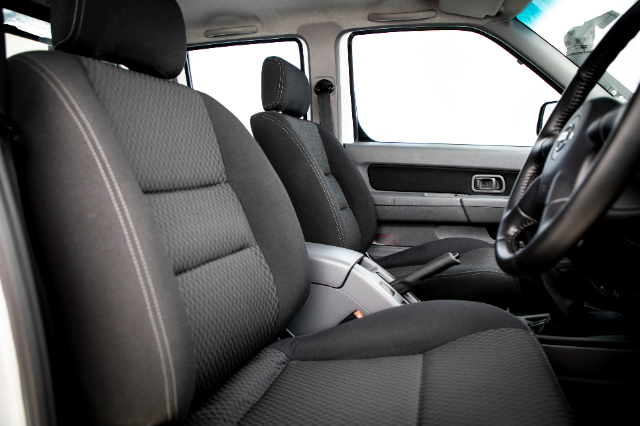
The interior finish includes cloth seats, front and rear headrests and a sliding rear window. Redesigned pillar seals ensure extra firm window closure for a quieter, dust-free interior with maximum protection against water seepage in wet conditions.
2. Power
The Nissan NP300 Hardbody’s diesel engines are the result of a 50-year heritage of engineering expertise. So when it comes to reliability, power and performance, the second generation 2.5-litre common-rail turbo diesel engine is as dependable and responsive as you can get. The potent combination of turbo and intercooler produces awesome power and torque and comes standard with a 5-speed manual transmission.
Quieter, with reduced vibration and carbon monoxide emissions, the Nissan NP300 Hardbody diesel engines also use eco-friendly oil filter cartridges which can be completely incinerated after use, meaning they are environmentally responsible and hardworking.
Clean and easy shift changes are provided by the 5-speed manual transmission, and a braking systems load-sensing valve increases brake power to the rear when moving large loads, ensuring the NP300 Hardbody makes light work of the toughest jobs. Engaging 4WD locks the transfer case in a 50/50 torque split for maximum traction from the front and rear axles. Auto-locking hubs come standard on the Nissan NP300 Hardbody 4WD models. When not in use, the hubs are automatically released, improving fuel economy.
Limited Slip Differential on 4WD Diesel models automatically transfers torque to the non-slipping drive wheel, allowing you to power out of virtually any situation.
3. Standard Safety Features
Central locking with remote
Standard in all Nissan NP300 HARDBODY Hi-Rider Double Cab models to protect your bakkie from theft.
Immobiliser and personally coded ignition keys
Standard on all Nissan NP300 HARDBODY models at Group 1 Nissan and will keep your bakkie safe from theft.
Solid ladder frame chassis
Absorbs the force of impact from the front in case of a collision.
Front Crumple zones
Minimise impact in the cabin in case of a collision.
Anti-lock Braking System (ABS)
Standard on all Mid-Grade, 4×4 and Hi-Rider models. ABS helps prevent your wheels from locking to help you steer around unexpected obstacles.
Nissan South Africa added a fourth variant to the Group 1 Nissan Micra range. Let’s take a look at the Micra Acenta Plus Tech model.
Styling
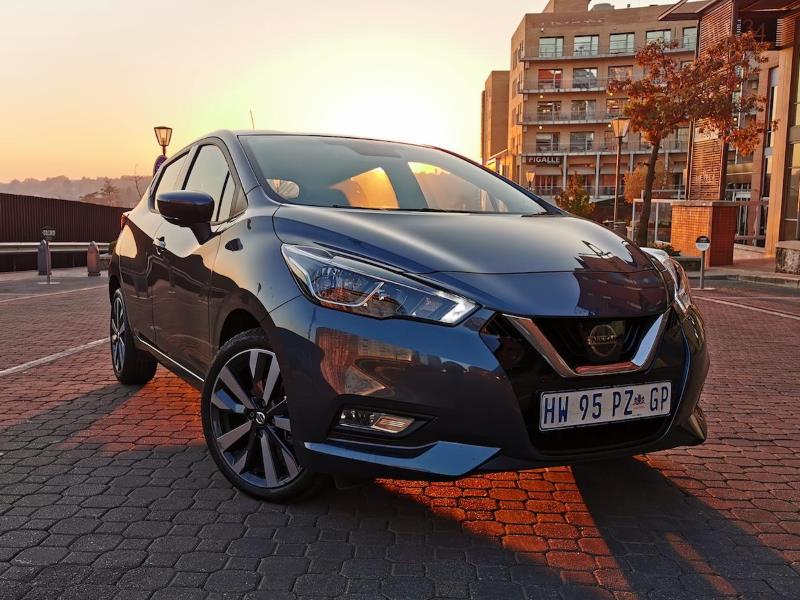
A car made for those who never miss an update on Instagram. When I stepped outside to take delivery of my Nissan Micra test car, I was more than chuffed to take the keys to this after seeing it. An older Micra could not have had more perfect timing than to pull in to a parking bay next to mine. I took a long hard look at these two cars and how far the design and styling of the Micra have come. Since its extensive update, it’s now a very desirable and sporty looking vehicle, especially this Acenta Plus Tech model I received.
It stood in the parking lot with prominent 17-inch alloy wheels and in the Echo Grey colour. As I got closer, the striking bi-tone black and orange interior immediately stood out. The Acenta Plus comes standard with the Energy Orange pack. The cabin also features a leather steering wheel as well as a leather shift lever and leather hand brake which is very nice, soft, touch considering it’s one of the places where your hands go most often. The D-shape steering wheel is thick and allows for a good grip whereas the gear lever is also chunky and sporty looking.
Additionally, it was also packed with features that include daytime running lights, front power windows, a manual aircon, cruise control, automatic headlights, six airbags and much more.
In case you don’t find the Acenta Plus Tech sporty enough, Nissan offers an extensive list of accessories for you to personalize the car.
The Drive & Performance
This Micra is powered by a 0,9-litre three-cylinder turbo petrol engine that puts out 66kW and 140 Nm of torque. The engine has been paired to a five-speed manual gearbox.
Ride quality in this model is excellent. Cornering is also effortless, the Acenta Plus Tech handles beautifully through corners and doesn’t feel unsettled at all. This is due to Nissan’s Intelligent Trace Control system which adjusts the brake pressure on individual wheels to help keep you on an optimal line through turns. This has been combined with the Intelligent Ride Control system, which applies subtle braking to prevent unpleasant upper body motion over bumps and enhance the overall comfort of your ride.
Despite the great drive, I found a big discrepancy with the Cruise Control system in what I set the speed to, to the speed it would display the car was doing. From the speed I set, the car would display that it was moving between 3-7 kilometres more than the set speed. I tested this many times and this discrepancy was there every time. “Sorry Officer, I set my car to the speed limit, but it decided it wants to go faster.” Tell me, who’s going to believe that story? But no it really does want to go faster it seems.
Space, Comfort & Convenience
The one gripe I have about the interior of this car is the visor. In combination with the height of the seat and the size of the windows, the visor is just too big and can partly block some of your forward vision. This becomes an even bigger problem for tall drivers as opposed to shorter ones.
The Micra Acenta Plus Tech model features Apple CarPlay and Android Auto compatibility via its 7-inch touchscreen and has a dedicated “Siri” button on the steering wheel. This will come handy when you need to mirror your navigation apps or for music streaming.
Seats are comfortable and are said to be “anti-fatigue seats”. There is sufficient shoulder space, headroom and legroom for adults all around the cabin, even tall passengers will feel comfortable enough.
The boot offers a sizeable 300 litres of space which expands to 1004 litres when the seats are folded down. Rear seats do a 60:40 split allowing for the transportation of long items while still having a passenger or two in the rear.
Cup holders are conveniently located in the centre console. For storage, a 1.5-litre bottle will fit in the door pockets while the bucket-type cubby accommodates for 10 litres or a 2.0-litre bottle.
ABS (Anti-lock Braking System) with EBD (Electronic Brake-force Distribution)
Seatbelts in the car have the points with ELR + Double Pre Tensioner + Adaptive Load Limiter + Height Adjust
Six airbags
Hill-start assist
The Nissan Intelligent Mobility technology package: includes an around-view monitor that gives you a virtual 360-degree bird’s-eye view of your car, moving object detection, Blind Spot Warning and Intelligent Forward Emergency Braking
Fuel Consumption
The Nissan Micra Acenta Plus Tech has a claimed fuel consumption of 5.1l/100km on a combined cycle and a fuel tank capacity on 41 litres. Depending on your driving style, the routes you travel and the traffic you encounter, this figure is always more under real-world conditions.
Price
Nissan Micra Acenta Plus Tech – R323, 500.00
As with all other Nissan vehicles, the Nissan Micra is covered by Nissan Assured and comes with a 6-year/150,000km Warranty; a 3-year/90,000km Service Plan; and 24/7 Roadside Assistance.
Somewhere between subcompact and compact, this Nissan crossover is sized right and priced right for South Africans
Nissan sold almost 10,000 Qashqais in its first half-year, and then almost 20,000 in its first full year on the market last year and is poised to do so again this year.
Weighing in at over 1,500 kilograms, it’s not particularly light for a car this small and it has 141 horsepower and 147 lb.-ft. of torque.
It’s a perfectly acceptable daily driver, the CVT making the driving experience smooth, all-wheel drive standard on our SV trim to get you through the winter, and a well-sorted suspension that offers impressive comfort despite 19-inch rims and decent handling for a small crossover. It’s the kind of quiet, forgettable drive that allows you to enjoy your tunes or podcasts on the way into the office. The SV trim also brings peace of mind to the commute with a whole array of driver safety aids, Nissan’s ProPilot assist providing a more proactive approach to the virtual safety bubble around your car. Even without the intelligent cruise control set to match speeds, with the ProPilot suite on the Qashqai will prompt just a hint of braking or throttle cutoff when encroaching on another vehicle’s personal space — control freaks would likely hate this, but daydreamers will appreciate this early intervention so it’s not a sudden alarming, blaring beep and lockup braking, just to avoid stuffing into someone’s rear bumper.
Its size is at the very smallest end of the proper compact crossover pool, smaller even than the Mazda CX-5 and Hyundai Tucson, but larger than most subcompact crossovers like the Honda HR-V, Chevy Trax and Nissan’s own Kicks. Its closest competitors would be the Jeep Compass and Subaru Crosstrek, and while space is a bit tight in the back seat, it’s plenty spacious enough for kids and easy to get in and out of. Although cargo space is not massive, the standard Divide-n-Hide cargo organizer makes the most of the space allowing a lower floor in standard five-seat configuration with 648 litres or a flat load floor with the 60/40 split rear seats folded yielding 1,730 L. On top of that, the two panels double as cargo walls to keep various items separate or as a cover for hidden storage if you find the standard cargo cover insufficient to keep belongings safe from prying eyes. It’s not earth-shattering, but it’s a little thing that becomes very useful in the life of a family car and much appreciated by busy people that like to keep their trunks tidy.
Upfront, there’s more of the same convenience, with the usual cupholders, door pockets with bottle holders and spacious armrest storage, but also a couple of extra trays in the centre console for cell phones or knick-knacks, and an easily accessed USB port ahead of the shifter and another in the cubby. The seats are similarly spacious but supportive, and the interior is well laid out. While visibility is compromised to the rear because of thick pillars, the 360-degree Around-View Monitor (available only on the SL trim) means it is as easy to park as anything, and a basic backup camera is standard equipment anyway.
South Africans can relish the fact that Apple CarPlay/Android Auto is standard on used Nissan Qashqai models for sale (2019). The native infotainment system offers a lot of good features, like standard 7-inch touchscreen, Bluetooth connectivity, navigation, and a home screen with some handy short cuts.
Nissan has been struggling across the board this year, with overall sales down 6.6 per cent, and virtually every model bleeding sales (or in some cases getting dismembered) compared to last year at the midway point, but the Qashqai and Kicks are bright spots in the corporate ledger. The Kicks proved its merit in a Comparison earlier this year, and now the Qashqai shows that Nissan’s broad portfolios of SUVs was the smart play in this market.
At the end of the day, the Nissan Qashqai offers a pleasant, low-stress driving experience, the latest tech, great practicality for a small package, and competitive value compared to cars its size. It’s easy to see why anyone who’s done their homework would at least look at the Qashqai and easy to understand why it’s actually a great little crossover.
We came across this fun road trip review and decided to share it with you. It really put us in the mood to go road tripping in a Nissan X-Trail ourselves!
Getting the keys to a test vehicle always makes you question what you should you do with the vehicle that’s relatable to owners and potential buyers. So I decided to take the Nissan X-Trail 1.6 dCi Tekna AWD on a road trip and do proper ‘holiday activities’ with it, as I had a wedding to attend in Durban anyway.
I left the office with the X-Trail, got home and started packing. I had the South Coast in mind as my first destination. I picked up my passengers, and off we went. All our bags fitted nicely into the 550-litre boot. Luggage space can be extended to 1405 litres with the seats folded, and full-sized spare wheel (size of 225/65 R17) can be found beneath its floor.
We travelled through the night and had a lovely and smooth drive. The contoured seats are well-padded and were very comfortable for the entire eight-hour journey. The X-Trail has an easy-to-use infotainment system, and we streamed our music through Bluetooth for most of the way. The stars and moonlight shining through the glass panoramic roof also enhanced the overall mood in the car. The powered sunroof with the one-touch operation is a standard feature on this derivative.
I think it’s taken for granted how a road trip in a comfortable vehicle can be a great bonding experience. If your passengers are cramped and uncomfortable, everything turns out miserable – the moods, the drive, and the experience. Road-trip-worthiness is definitely a factor that more family buyers should keep in mind when purchasing a vehicle.
The Drive
There are three engines in the range. Powering our X-Trail to the coast was a turbocharged four-cylinder 1.6-litre diesel that provided enough power to drive at a leisurely pace through N3 traffic. It’s not the most energetic SUV out there, with rated outputs of 96 kW of power and 320 Nm of torque. The engine is mated to a 6-speed manual gearbox and has a very competitive fuel economy rating.
Acceleration from 0-100 km/h happens in 11 seconds, so you have to be a little patient with it from a standstill. The diesel engine sounds a little grumpy under acceleration but settles down when cruising. It also tends to roll back easily on inclines due to some take-off lag, but it does have an Auto Hold button which can be used to assist in these situations. The other two engines in the range are 2.5 petrol (only available with a CVT) and 2.0-litre petrol (only available with FWD).
All of them have a fuel tank capacity of 60 litres and the 1.6 diesel has a claimed fuel consumption of 6.2L/100 km for an urban cycle. During my time with the X-Trail, I averaged around 7.2L/100 km, which is quite a decent figure. The SUV is also equipped with Idle Stop/Start to help reduce fuel consumption and emissions.
The other two engines have much higher consumption figures, so if you don’t really need a 7-seater for daily use, then the 1.6 diesel (which is a 5-seater as standard in Tekna trim) is your best bet. It’s also loaded with all the bells and whistles as standard.
Interior
ISOFIX child seat anchorages on the rear seats are standard, along with Driver, Passenger, Front Side & Curtain Airbags. As aforementioned, the easy to use, and logically presented, infotainment system allows compatibility with CD/MP3/USB/AUX/RDS and Handsfree Bluetooth connectivity all played through six speakers. There’s also Smartphone integration through the Nissan Connect Apps available for Tekna models. Furthermore, Tekna models also have the Navigation system with a 7-inch colour touchscreen display as standard.
Other standard creature comforts include:
Climate control with dual-zone adjustment and rear vents
Bottle and cup holders with a heating and cooling function in the front holders
The interior has a very neat layout, with everything within easy reach of the driver. The high seating position and massive windscreen allow for good forward visibility – I could take in that wide view of beautiful mountain scenery and the guy skipping a robot just as easily. Actually, all-round visibility from the driver’s seat is excellent. The driver’s seat has a 4-way power adjustment, which is so much more convenient than manual adjustment. I know I’ve grazed my knuckles in some cars having to pump-action my seat up or down, just to suit my small frame. Overall the materials in the car, such as the plastics and leather seats, look more durable than plush, which also makes it easy to clean. This is convenient not only for everyday use but also after a tiring holiday trip, as you won’t have to spend so many hours cleaning it up.
Space and Comfort
Headroom and legroom in the X-Trail are pretty good. Access to the rear seats has been made easy with a 77-degree swing for the rear doors, allowing a hassle-free approach to loading the kids or a cooler box.
The 1.6 diesel only seats five passengers, but other derivatives can seat up to seven people with their addition of a third seating row. The back seat in the X-Trail 1.6 dCi allows for a 40:20:40 split, with a single-action folding mechanism, manually-reclining backrests, a folding seat cushion (60:40 split), as well as a slide function to vary the space allocation between the cabin and the boot.
Safety Equipment
The Nissan X-Trail was awarded a five-star Euro NCAP rating for its safety equipment and crashworthiness. Privacy glass comes standard on all derivatives of the X-Trail. Here’s a list of standard safety equipment on the X-Trail 1.6 dCi Tekna AWD:
Anti-lock Braking System (ABS)
Electronic Brake Force Distribution (EBD)
Brake Assist (BA)
Vehicle Dynamic Control (VDC)
Hill Start Assist (HSA)
Intelligent Around View Monitor + Moving Object Detection
Intelligent Lane Intervention
Intelligent Blind Spot Intervention
Cross-Traffic Alert
Intelligent Emergency Braking
Intelligent Forward Collision Warning
Intelligent Auto Headlights
Of all these great systems, the lane intervention beeping can be really annoying, and that’s no lie. This beeping is to alert the driver when crossing over lines, but it also activated when I was overtaking and switching lanes. Tekna models are the only two in the range to have all these systems fitted standard. However, the 1.6 dCi variants and the FWD derivatives lack the Hill Descent Control (HDC) feature for some reason.
All variants across the line have a braked towing capacity of 1,500 kg and an unbraked towing capacity of 750 kg.
Nissan X-Trail Accolades
In 2017, Nissan X-Trail sales increased by six percent over 2016 and a record of 814,495 units have been sold globally. These figures have made this SUV the fourth best-selling vehicle in the world.
Verdict
I travelled from Johannesburg to the South Coast, to Durban, and back to the South Coast where I adventured on the longest zip line tour in Africa (apparently). Then I made my way back to Johannesburg. It was the first time I road-tripped with a manual vehicle, which wasn’t a problem at all. Too many people have this ‘inconvenient’ or ‘difficult’ perception of a manual vehicle, but I guess it just takes a little more practice than automatic, and really it’s not all that bad. Other than the rolling-back on steep hills (of which are plenty on the South Coast), the Nissan X-Trail 1.6 dCi Tekna AWD was a pleasure to drive and travel in. Its diesel engine is competitively frugal, and the vehicle is well-equipped. I cannot emphasize the levels of comfort and its supple ride enough. You can even indulge in light off-roading as well, so the X-Trail isn’t afraid to get down and dirty.
Jump behind the wheel of an X-Trail at your nearest Group 1 Nissan dealership!
The South African double cab bakkie market is easily on of the most tightly contested vehicle segments in SA, with South Africans being one of the largest fans of the utilitarian aspects of being able to lug around nearing one tonne of payload and three times that via a tow hitch. This has allowed the top contenders, in the form of the Ford Ranger and Toyota’s iconic Hilux to constantly shift in the realm of 3 000 units each month, both over 3 times that of the third and fourth-placed Nissan Hardbody and Isuzu KB.
This is overall contrasted with tough economic times, that has resulted in the underlying fact that the utilitarian aspects come with the typical bakkie bouncy ride, noisy diesel motors and cramped rear seats that are not ideal traits for every day, especially since the second daily small car is fast becoming a dream. The packages are improving in line with this shift to more of an everyday usage focused vehicle, but still hindered by the use of load-friendly leaf spring set up, in all but one – enter the new Nissan Navara. Understanding this fluid use of the vehicle that mainly encompasses traffic jams rather than the extreme off-road expedition, Nissan engineers have ditched the traditional bakkie setup for that of a more driver-friendly multi-link coil-over set-up.
The Navara is incredibly good at the everyday ‘leisurely’ activity that is traffic, driving to and from work and even gravel roads. The ride is easily the best in class, better than even the exceedingly German VW Amarok.
CABIN
The interior of the Navara is incredibly well-appointed with standard features on SE models including a touch screen Sat Nav system with CD player, AM/FM Radio, AUX, USB and Bluetooth connectivity with steering mounted audio controls. Top-spec Nissan Navara LE models at Group 1 Nissan get leather interior, electric & heated seats, keyless entry and start, reverse camera, rear PDC and LED daytime running lights.
The interior is upmarket and comfortable. It feels comparable to a premium SUV rather than a bakkie and offers very good space front and rear, the level of the standard spec is really impressive and does a good job of helping you forget about the bakkie roots. It’s incredibly refined and cancels out wind noise, vibrations and harshness – easily class-leading in this aspect
DRIVETRAIN
Powered by a twin-turbo 2.3-litre engine that has 140 kW and 450 N.m, it’s happiest when cruising along at freeway speeds. Overtaking power is good and the low down torque from 1 500-2 500 RPM offers incredible tractability and in town, builds speed very quickly with little effort. The only complaint is the noise when overtaking as the engine does get a little loud when pressing on, but this is a very small gripe. The claimed fuel consumption figure of 6.5 l/100km is rather optimistic with a best of 9.1 l/100km in the combined cycle being more realistic. The 7-speed Automatic is also smooth and feels like a good match to the engine, although some adjustment must be made when cruising as the gearbox will often gear down when accelerating with anything other than ¾ throttle, even when you don’t intend on such, likely more orientated to accommodate 3.5-ton towing capacity.
4X4 TOYS
The new Navara is again class-leading in the approach and departure angles offering 33 degrees, on the former and 27.9 degrees the latter. Ground clearance sits at 226 mm, which is impressive but may be hampered by the standard side steps. Low range, diff-lock, and selectable 4WD are standard and the electrical goodies like hill ascent and descent control come with the territory.
The New Navara is an incredibly good bakkie and with a starting price of R 519,800 at Group 1 Nissan, offers very good value for money for those not overly focused on the bakkie aspects of the vehicle. The range will expand later to include other offerings but at this point, the pick of the bunch is the top-spec 2.3 LE 4×4 Auto.
The Nissan NV200 for sale is a light cargo van built as a complement to Nissan’s larger NV full-size van starting in 2010. In the very price-sensitive field of commercial and small-business vans, it is one of the most inexpensive options available. Other than an attractive price, tradesmen, small business owners and regular buyers alike will also appreciate the excellent degree of customizability and the low cost of ownership that the 2018 Nissan NV200 brings.
What’s New for 2018?
In 2018, Nissan updated the complement of onboard electronics for the van. The 2018 Nissan NV200 now comes standard with a rearview camera, a 5.0-inch LCD display and Bluetooth voice and hands-free texting functions. Aside from its feature selection, the Nissan NV200 remains unchanged since its 2010 model year debut.
Top 10 Reasons to Buy a 2018 Nissan NV200 – The Pros
1. Inexpensive
The biggest selling point is that the 2018 Nissan NV200 is the cheapest cargo van on the market today by far. At around the same price point as a compact passenger car or crossover SUV, it delivers a lot more cargo room and hauling ability. It is also priced well below most of its competitors in the light cargo van segment, making it a good value purchase.
2. Attractive
Vans are not designed to be appealing, but the 2018 Nissan NV200 manages to avoid looking boxy or ugly, thanks to its rounded lines and subtle accents integrated into its cargo cab. Likewise, its interior feels more car-like than some competitors when you are in the driver’s seat.
3. Standard Technology
The addition of standard Bluetooth and a rearview camera to the 2018 Nissan NV200 gives it additional value as both a private and a commercial vehicle. While those are common in many consumer cars, they are high-end options on many commercial vehicles. For a van, a rearview camera is almost a must, and Bluetooth makes it easier to safely conduct business while on the go, so this is a big plus for the NV200.
4. Manoeuvrable
While it is large to accommodate a big cargo load, the 2018 Nissan NV200 is not actually much longer than most mid-size consumer vehicles, which makes manoeuvring it around city streets or through built-up neighbourhoods much easier than a standard van. The standard rearview camera makes it even easier when it comes to reversing.
5. Modular Cargo System
Nissan has made it very easy to customize this van and adapt it to your changing business needs. Inside the cargo compartment of the 2018 Nissan NV200, you will find 20 wall-mounted and six optional floor-mounted cargo points, which allow you to attach shelves, storage lockers or equipment to the walls without welding or drilling. This makes adding, removing or rearranging your storage very easy.
6. Sliding Door Option
Another optional customization feature offered on the 2018 Nissan NV200 is its optional sliding door. Models with that option have a minivan-style door on the passenger side that allows easy access to the cargo area without having to use the rear doors. For many business applications, such as residential deliveries, this can greatly speed up the process and make it more efficient.
7. “Mobile Office” Seating
The front cabin of the 2018 Nissan NV200 is filled with little touches designed to make it easier to keep your business workflow going even while in transit. There is storage for files and laptops in the centre console and dashboard, helping important items not get lost, but the most innovative is the folding passenger seat. It can be folded down to create a small desk, which can make it easier to work on the aforementioned laptop or files while remaining in the driver’s seat.
8. Fantastic Taxi Model
For the 2014 model year, Nissan introduced a new version of the NV200 specifically for use as a New York City taxi, before expanding the availability of the model to other markets. This model is filled to the brim with excellent comfort touches, including vinyl upholstery, full windows and a complement of nice features for the passengers, including a panoramic sunroof and USB ports and even a power outlet.
9. Good Economy
The Nissan NV200 does slightly better than its van rivals when it comes to keeping fuel costs down. It is rated at 24 miles per gallon city, 26 mpg highway and 25 mpg combined, which puts it at above average for the class.
10. Excellent Warranty
Nissan offers a great warranty on its commercial vehicles, which includes the NV200. Its new car warranty lasts for five years or 100,000 miles, which is longer than most other manufacturers. This is good news for both larger fleet buyers, who are more likely to see defects, and small businesses, which may be running on lower margins.
Conclusion
The 2018 Nissan NV200 is a vehicle focused on one thing: providing an excellent value when it comes to carrying cargo and the various business applications that accompany that. It is inexpensive and easily tailored to the needs of each particular business. It is not as flashy as some alternatives, but it delivers good and consistent value which will be reflected in your bottom line at the end of the day. That makes it an excellent choice.
Nissan South Africa has introduced what it bills as “the most comprehensive range of manufacturer-approved accessories yet available on a pick-up” with the launch of the new Navara.
According to the local arm of the Japanese automaker, some 67 approved Nissan accessories are already available, ranging from airbag-safe waterproof seat covers and cattle rails to LED lighting for the tow bar, off-road performance coil springs and 7-inch LED spotlights.
“Our accessory team worked alongside the approved supplier teams to prepare and validate the range of accessories in step with the local durability testing of the all-new Navara,” said Tony Minnie, head of aftersales at Nissan SA.
“This means that every single accessory is available at Group 1 Nissan from launch and is approved for fitment on the Nissan Navara,” he explained.
The accessories have been grouped into various applications, including cosmetic upgrades, off-road applicable upgrades and “functional” upgrades.
The cosmetic accessories include riveted fender flares, a black or alloy nudge bar and matching rear sportsbar, a wide range of decal kits and head- and taillamp surrounds. Then there’s a bonnet guard, tonneau cover and window visors with a matt black treatment.
The range of off-road-ready accessories, meanwhile, includes a heavy-duty steel rear bumper with high-lift jack points, as well as side steps with side rails that extend their protection across the front fenders to the new replacement bumper.
The bumper likewise adds high-lift jack points and fits flush to an underbody protection plate-kit. There is also the option of a winch with either a steel or synthetic cable and heavy duty recovery points.
Other accessories include canopies, a range of alloy wheels, rubberising (or a loadbox rubber mat), smash-and-grab tint, headlamps covers and Thule roof racks.
“In our preparation for the new Navara, we spent a great deal of time with Navara enthusiasts and have subsequently added some very special items to our canopy range,” said Minnie.
“Beside the two fibreglass canopy options, you can also specify a stainless-steel version and add items such as side gullwing doors, a roof mounted table, LED interior lighting and even a 3/4 or full kitchen unit,” Minnie said.
Nissan says all of its dealers have been “fully trained” on the fitment of these new accessories and that every dealer has been equipped with the tools required to ensure that fitments are done to manufacturer standards.
“Owners can have any single item fitted by a Nissan dealer and they will retain their vehicle warranty and receive a fitment and workmanship warranty for the accessories as well,” explained Minnie.
“These accessories were developed in partnership with some of the best off-road companies in the world, including Ironman 4×4, but they will only be available for fitment from an approved Nissan dealer.”
In addition, Nissan says it will offer a special launch kit in partnership with Ironman 4×4, which includes the replacement bumper, recovery points, underbody protection plates, a suspension upgrade, side steps (with additional side rails) and a steel rear bumper.
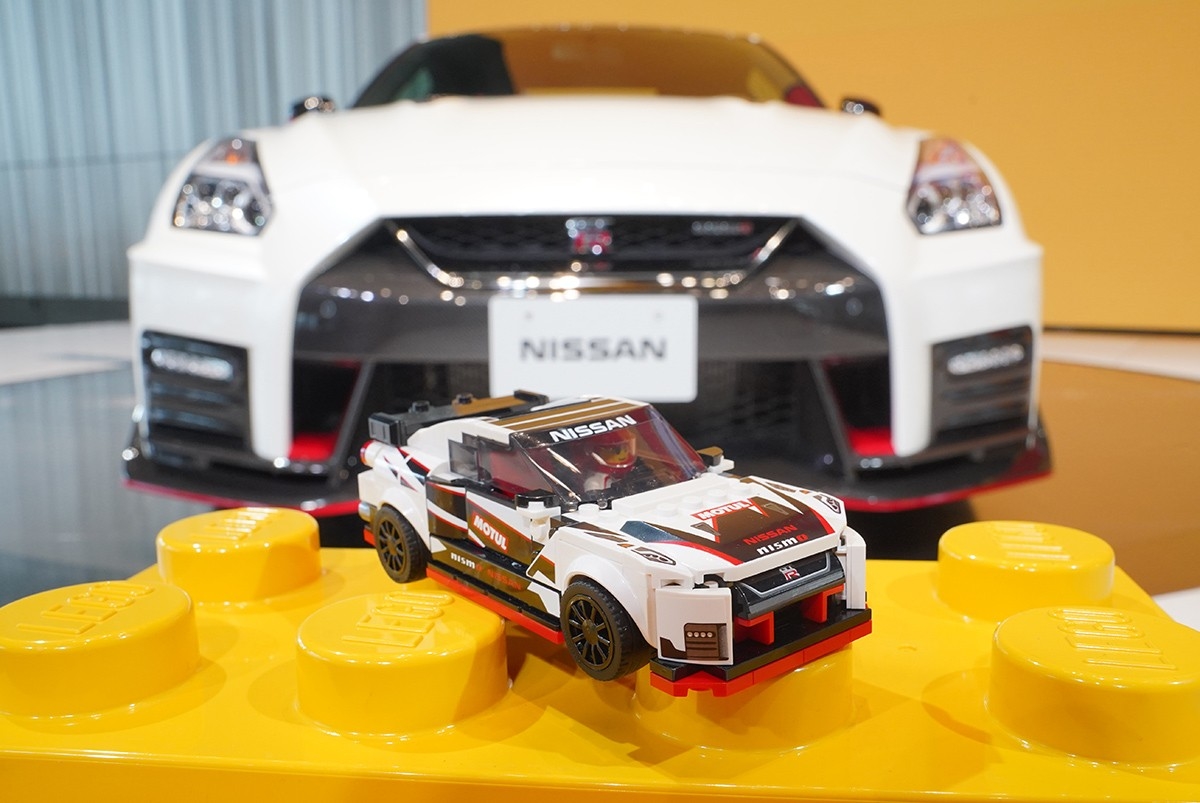
Lego Speed Champions Nissan GT-R NISMO (NISsan MOtorsport) pays tribute to the legendary Japanese supercar. The set will be available in the first half of 2020.
Since the introduction of the Lego wheel in 1962, cars have played a central role in thousands of Lego sets. The Lego Group and Nissan have revealed a model that pays tribute to one of the most iconic Japanese supercars, the Nissan GT-R NISMO. This is the first partnership between Lego and a Japanese automaker.
The Lego model was revealed by Lego Group CEO Niels B Christiansen and Asako Hoshino, executive vice president at Nissan, at the automaker’s global headquarters in Yokohama today.
Niels B. Christiansen says: “In addition to offering a wonderful and fun building and play experience, we hope the model will also inspire children to learn more about engineering and how to create things in real life. Just as engineers across decades have improved the design and performance of this car, children build, unbuild and rebuild during play – stimulating and developing crucial skills, such as creativity, resilience, problem-solving and critical thinking. Inspiring them to become the builders of tomorrow is our mission.”
Asako Hoshino says: “The Nissan GT-R and the Lego brand are both renowned and loved by fans of all ages throughout the world, and we are honoured to be the first-ever Japanese car manufacturer to partner with the Lego Group. Many of our Nissan customers can trace their automotive passion back to when they built Lego cars as children. With this partnership, everyone can be a `takumi’ – the specialized craftsmen that build the GT-R. And, it’s the GT-R’s 50th anniversary this year, so what better way to celebrate than to share the GT-R with Nissan and Lego fans around the world.”
Iconic taillights recreated in bricks
The model has been available globally since January 2020. It’s one of the first in the 2020 Speed Champions themed sets, which will be 25% bigger than in previous years. It is made from 298 Lego elements and captures the authentic and intricate details of the life-size race car in a relatively small Lego model. This posed an interesting challenge for Lego design lead Chris Stamp:
“In Lego Speed Champions, we always aim to include new types of racing vehicles. And when we focused on drifting and racing, the record-breaking Nissan GT-R, and especially the new GT-R NISMO, was at the top of our wish list. Authenticity is always our main concern, and we spent a lot of time exploring different building techniques to correctly recreate the taillights, as they are one of the most recognizable details on the car. I am really happy with the end result.”
Hiroshi Tamura, Nissan’s chief product specialist for the GT-R – known informally as “Mr. GT-R” – gave the scaled-down Lego version his stamp of approval: “The GT-R has been part of my life since I was 10 years old. Working with the Lego Group was like awakening my inner 10-year-old self to rediscover what makes the GT-R so special to me. It’s amazing how much the Lego Group’s attention to detail reminds me of our own craftsmen.”
The real Nissan GT-R is available from Nissan Cape Town and while the LEGO GT-R won’t be for sale at dealerships like Group 1 Nissan – it would be an exciting experience for a little one to see the real Nissan alongside their own LEGO GT-R Nismo.
The Nissan Patrol stands out for true 4WD capability in a modern world flooded with soft-roader family SUVs. For 2020, the Patrol arrives with a facelift and enhanced safety kit to go with its staple go-anywhere, tow-anything chops.
It’s sporty like a heavyweight boxer. Its 5.6-litre petrol V8 produces 298kW and 560Nm without a turbocharger. Pure muscle and the “utility” part from SUV shines through. Leathery seating for eight. It tows 3500kg. There’s a 140L fuel tank. And its low-range transfer case and 4WD drive modes could haul you to Everest base camp.
It’s absolutely huge, but you don’t need a truck licence to drive the Patrol.
It’s got some serious style – its recent facelift bringing new LED lights, bumpers, grille, bonnet and fenders.
The living space
It’s a big climb up into the cabin but, once you’re there, it’s like settling into a business lounge.
Very polite. There is old-school quality inside. Faux wood trim abounds, there are comfy and wide leather seats and even pleated leather for the doors. The centre armrest’s the size of a cow, so long distance cruising is utterly relaxed.
The second-row seats should have their own postcode. Sure, it’s a large SUV but interior space is mighty. No problems fitting an adult between two child seats.
Give me a highway and I’m in heaven in this thing. It’s brilliantly smooth for cruising, has radar cruise control and handy safety kit such as blind spot warning and it pulls you gently back into lane if you stray.
The shopping
The weekly shop fits in even with eight seats up. Brilliant.
With just the front seats up it’s a van. I fitted a 2m-high bookcase in the back.
Not having an automatic tailgate is a pain. If you’re short it’s a big reach and a massive thing to haul down. Thankfully, it has automatic soft close.
Parking is made easier as Nissan fit an around view monitor as standard with parking sensors front and rear.
The family
With eight seats, it rivals people-movers. You can fit a rugby sevens or netball team as well as the driver.
The top-grade Ti-L has seven seats, which is probably enough. The centre row has the best seats in the house. The back has roof-mounted air vents.
The verdict
The Patrol’s mammoth size means it’s one for adventuring rather than urban duties. Yet the whole family loved it. The interior needs modernising but the joy comes from the acres of cabin space, rumbling V8 and magic carpet ride.
The Patrol’s cheaper at Group 1 Nissan than the equivalent Toyota LandCruiser and it’s the pick for the petrol V8 faithful. It looks a bargain against its opposition, is full of talent and personality.
Nissan Patrol Ti vitals
Warranty/servicing: 5 years/unlimited km, 3 years/60,000km
Engine: 5.6-litre V8, 298kW/560Nm
Safety: 6 airbags, AEB, blind-spot monitor and intervention, rear cross-traffic alert, adaptive cruise, lane departure warning and intervention
With Nissan’s previous-generation small car soldiering on as the Micra Active in the so-called lower B segment, the Nissan Micra for sale took a leap into the upper B segment to directly take on its cousin the Renault Clio, as well as the VW Polo and Ford Fiesta.
Launched in South Africa a while ago, the grown-up new Micra is reinvented as a larger, classier and more technologically-advanced car, with pricing more or less on par with the opposition. The car’s metamorphosis starts with a much more palatable design than its odd-looking predecessor.
Based on the Clio and built in France, the Micra got a fresh and modern ‘Eurocentric’ shape that radiates a youthful vibe. With a length of 3999mm it’s considerably larger than before too, making for a much roomier cabin. The boot’s grown to a fairly generous 300 litres, expandable to 1004 litres when the 60:40 split rear seats are folded down.
It’s under that stylish sheet metal that an even bigger revolution’s taken place. The cabin is one of the classiest in the segment, with textures and materials that radiate the feel of a more expensive car. The dashboard has a soft-touch surface that gives off a quality feel, while the armrests get the same pleasantly spongy covering. The gadgets are also all the latest spec, with the obligatory large touchscreen and music/phone connectivity.
Ergonomically it’s a success too and this includes a height and reach-adjustable steering column which allows anyone from a ballerina to a bouncer to find a comfortable driving position. Nissan says a driver who is 2.03 metres tall can fit comfortably behind the wheel. Spec levels are very generous as well, with even the baseline Micra getting features like cruise control, automatic headlights, electronic stability control, hill start assist, ABS brakes and six airbags.
To begin with, there are three Micra derivatives, all powered by the same three-cylinder turbocharged 900cc petrol engine as found in the Clio. Drive is to the front wheels via a five-speed manual. Performance, given the modest engine size, is reasonably punch – the car was able to cruise at the national speed limit with not too much effort, and even had some overtaking poke.
The driving experience is a pleasant one. Nissan’s compact car has a very solid feel, cruising over bumpy roads with good torsional rigidity and nary a rattle to be heard. It’s a refined little hatch too, with good noise insulation.
Three specification levels are available: Visia, Acenta and Acenta Plus. Apart from the features already mentioned above, the Visia comes standard with 15-inch steel wheels, daytime running lights, front power windows, a manual aircon, and a Bluetooth and MP3 compatible audio system.
The Acenta adds 16-inch alloy wheels and front fog lights among other features, while the Acenta Plus lays on 17” alloy wheels, a leather steering wheel and a colourful dual-tone ‘Energy Orange’ interior (pictured above).
The Acenta and Acenta Plus also have an 18cm touch-screen colour display for music, messages and maps through Apple CarPlay in addition to the MP3, USB and Bluetooth in the Visia model.
Nissan has an extensive array of personalisation offering for the new Micra, which can be pimped-up with decals and styling packs, and the range was expanded in 2019 with additional derivatives, starting with a cheaper 52kW one-litre normally aspirated version.
If you’re looking for a used Nissan Micra – check out what’s available at Group 1 Nissan.
Prices include a six-year or 150 000km warranty, a three-year or 90 000km service plan and 24/7 roadside assistance.
When you buy a car it should be a fun, exciting experience. Browsing vehicles, choosing the right one, then slipping behind the wheel of a bright, shiny new motor, ready to hit the road in style!
But often the number of questions associated with purchasing a new vehicle can turn a thrilling time into a stressful one. Between worrying about finance, knowing what to ask the dealer, and even deciding on which type of car to choose, the purchasing process can be a tricky one if you’re unfamiliar with it. That’s why Group 1 Nissan put together an extensive guide, but here’s a list of tips to guide you all the way from browsing to buying with as little hassle as possible.
1. Decide what you can afford
It may seem like a given, but working out how much you can afford to spend on car payments every month is a crucial first step to buying a new vehicle. It’s no good deciding on the car of your dreams, and then realising you won’t be able to afford it – or worse, crippling yourself with debt in order to make your payments.
That’s why before you buy a new car, it’s imperative that you calculate what you can realistically afford to spend on repayments every month. Also, make sure to budget for essentials like car insurance, and occasional repairs too.
2. Decide what type of car you need
Again, perhaps an obvious step, but another important one nonetheless. Deciding on the make and model of the car you need, rather than want. If you have a family, there’s no point investing in a two-seater sports car. Similarly, if you’re an urban warrior, there’s no reason to spend more than you can afford on a giant 4 x 4.
That’s why in order to ensure you choose the ideal car for your lifestyle, first make a note of exactly what it is you need from a car. Once you have a clear idea of the necessary specs and features, you’ll have narrowed your search considerably. After this process, you’ll have a clearer idea of which type of vehicle would suit you best.
3. Secure your financing
Some dealers may try to persuade you that securing financing is only necessary once you come to actually purchase a vehicle. In fact -walking into a dealership with approved financing gives you more negotiating power and allows you to find the best interest rate.
What’s more, having your financing approved before visiting a dealership may leave you with extra money to pay associated fees and taxes. These are costs that you might otherwise have to cover yourself after purchasing. As such, applying for vehicle finance before making an actual purchase can give you a welcome advantage.
4. Choose a dealership
Once you have a shortlist of potentially suitable vehicles to purchase and have secured financing for yourself, it’s time to visit a dealer. In South Africa, you’ll want to make sure any dealer you choose is a member of either the Retail Motor Industry Association (RMI) or the Independent Dealer Association (IDA). Both of these associations are accredited organisations that are regulated in order to ensure fairness, compliance and best practice standards. Before you approach any dealership, first make sure it is affiliated with either of these organisations in order to protect your rights as a consumer.
5. Go for a test drive
Now comes the most important part of the purchasing process – your questioning of the dealer. Before you make a decision on which car to buy, you’ll need to make sure you know it inside and out. That means asking the dealer questions about service plans, specifications, warranties, optional extras, or any other information you may need. This is also your opportunity to take your shortlisted vehicles for a test drive. Maybe even a few, if you feel it necessary. Make sure you know how well the car handles, how comfortable you feel driving it, and how confident you are behind the wheel before ever making an offer. And when it comes time to discussing price, remember that the door to negotiation is always open – and can sometimes lead to you paying less than full sticker price too!
6. Sign the paperwork
Once you have decided on your vehicle, and have accepted the price as quoted to you by the dealer, you will need to sign the paperwork in order to finalise the purchase. Make sure that you have your valid South African driver’s license with you, as well as proof of car insurance, and sign the contract once the vehicle is ready for delivery and you are fully satisfied with it.
7. Take a tour of your new car
While you could just as easily familiarise yourself with your new vehicle at home with the driver’s manual in hand, having your dealer take you through the various features and functions of the car will allow you to ask on-the-spot questions. Make sure your dealer runs through the dashboard functionality with you, any technological features such as Bluetooth, the type of petrol your car takes and shows you how to open your bonnet and petrol cap too. Lastly, make sure you have a copy of your car’s instruction booklet, service manual and original registration, and you’ll be ready to drive off and rule the road!







 The Nissan Fan