UNLIKELY to cause as much excitement as a full set of those ridiculous miniatures from Woolworths, the compact Nissan Qashqai line-up is complete.
That price puts the top-shelf Qashqai, pronounced “cash-ky” for those confused, within stretching distance of lower grade prestige variants like the Audi Q2 or Infiniti Q30, but right in the mix against the best compact SUV offerings including the Mazda CX-3 Akari, Toyota C-HR Koba and Hyundai Kona Highlander.
VALUE
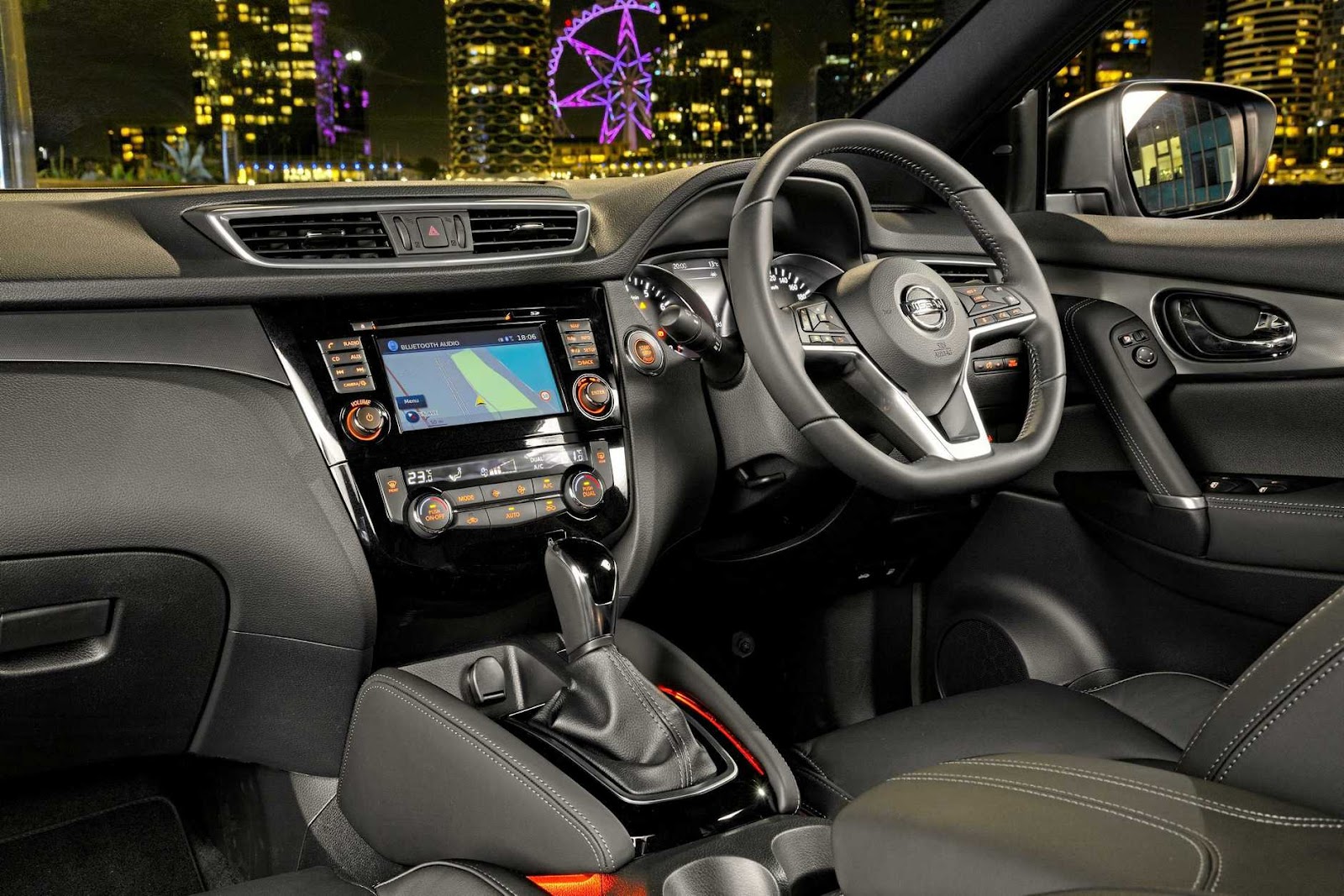
Nothing is left on the options list, and for the slightly pricey jump over the base ST model you get the special leather 3D quilted seats with electric adjustment for the front two chairs, keyless entry with push-button start, seven-inch colour touchscreen with satnav and digital radio, panoramic sunroof, as well as dual-zone aircon.
The Qashqai was updated in December when Nissan introduced more sound-deadening materials and improved use of soft-touch materials.
Stop-gap N-Tec models are still being phased out and while they are equipped similarly, the Ti adds the better seats, radar cruise control and functionality that can steer the car if it starts to wander outside the lane without indication.
Servicing intervals are every 10,000km or annual.
The warranty is short by mainstream standards at three years or 100,000km, with roadside assist for the same period. Kia leads the way with seven and unlimited kilometres, while Hyundai, Mazda and Volkswagen (selected models) offer coverage for five years.
An extended warranty deal is available for another three years as long as it hasn’t covered more than 150,000km.
DRIVING
Across the range is the standard four-cylinder petrol engine and unfortunately, the Ti doesn’t gain any additional zip.
That doesn’t mean it’s a slowcoach. The continuously variable transmission works well in tandem with the engine (often those transmissions can sound whinier than Phil Gould) but it lacks some punch for those who like more urgency under their right foot.
With a firm ride, it borders on sporty, although it mostly feels adequate in most departments – doing its intended job as a family-hauler reasonably well.
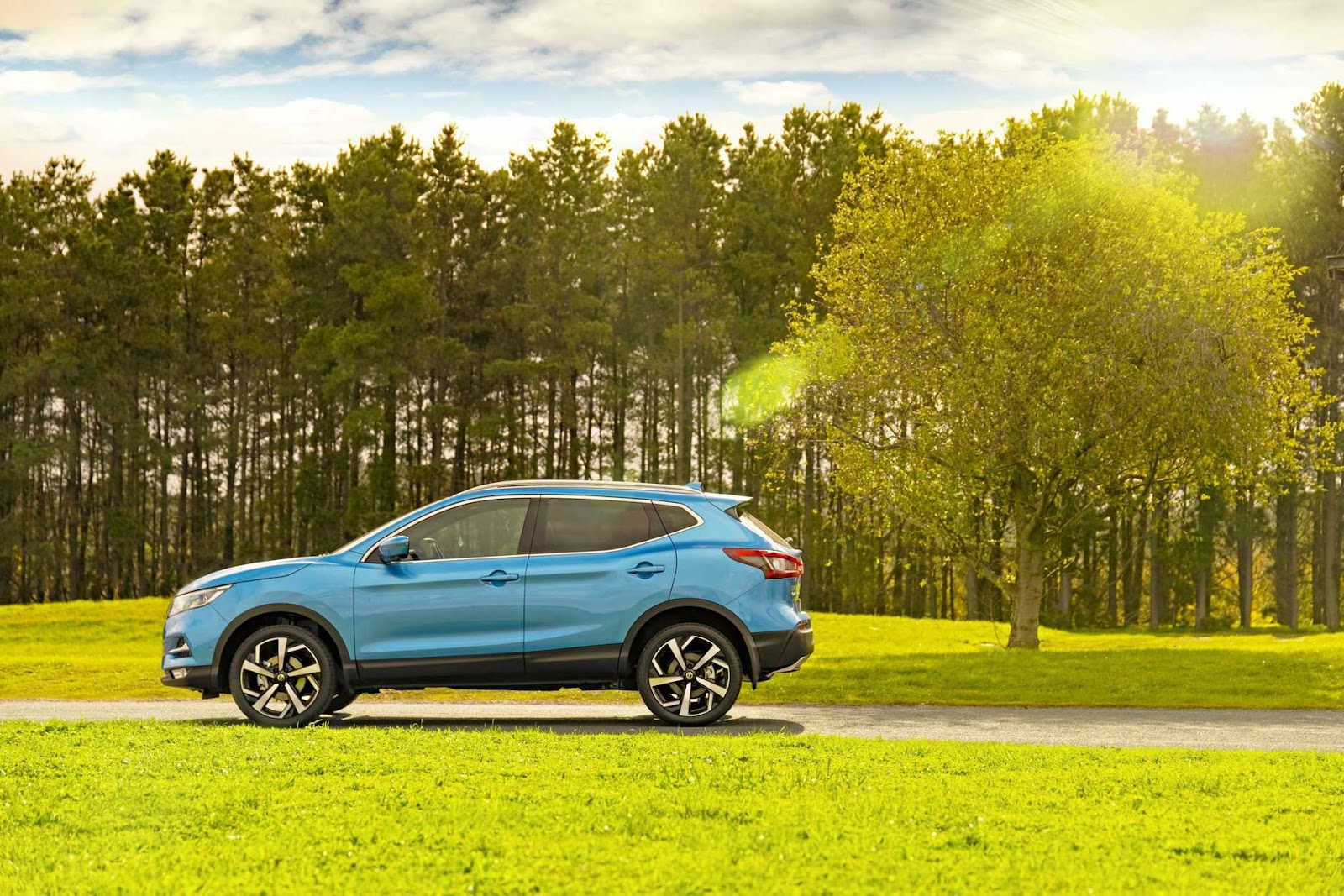
Looking the part, the Qashqai has European appeal, especially impressive with the blue external colour scheme and the 19-inch diamond-cut alloys. Other colour options are various shades of grey, red, black and white.
Boot space is impressive by compact SUV standards and good enough for a couple of large suitcases.
Drop the rear seats and the 430-litre space expands to just shy of 1600.
SAFETY
Only available on this Ti model, the radar cruise control function can maintain the Qashqai’s position behind vehicles at three pre-set distances that can be set by the driver.
While it works, the Qashqai system felt like it was operating in waves of momentum when following slower cars … not something we’ve experienced before with Nissans and we’ll take it as an aberration rather than the rule.
It also comes with autonomous emergency braking which can apply the brakes to avoid or lessen an oncoming accident, front and rear parking sensors, 360-degree camera view, blind-spot warning, automatic high beam and rear cross-traffic alert.
VERDICT
Sitting atop the range, the top-shelf Qashqai Ti, from Group 1 Nissan, is a contributor rather than a star player in a competitive SUV arena. Looking good and with reliable performance, the Qashqai SUV meets expectations.
AT A GLANCE
NISSAN QASHQAI Ti
ENGINE 2.0-litre 4-cyl, 106kW/200Nm
SAFETY 5 stars, 6 airbags, AEB, lane departure warning, surround cameras with rear object detection
If you’re a car buyer on a budget, the market is just getting better and better for you. Carmakers are responding to the massive growth of the B-segment and your choice of vehicles under R200 000 seems to grow daily.
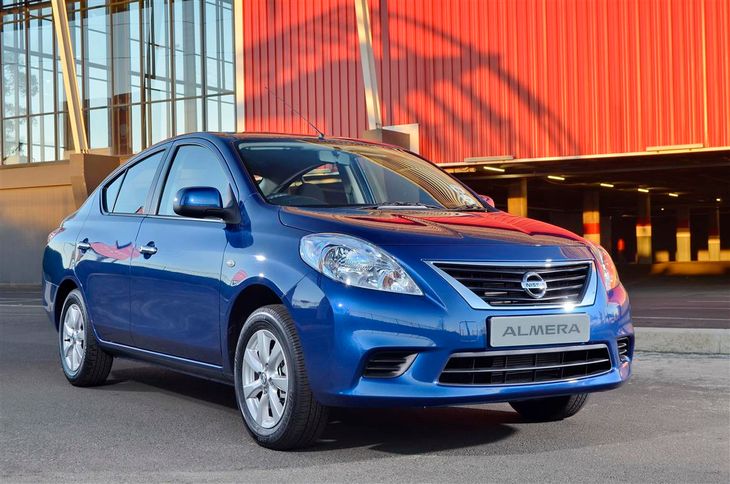
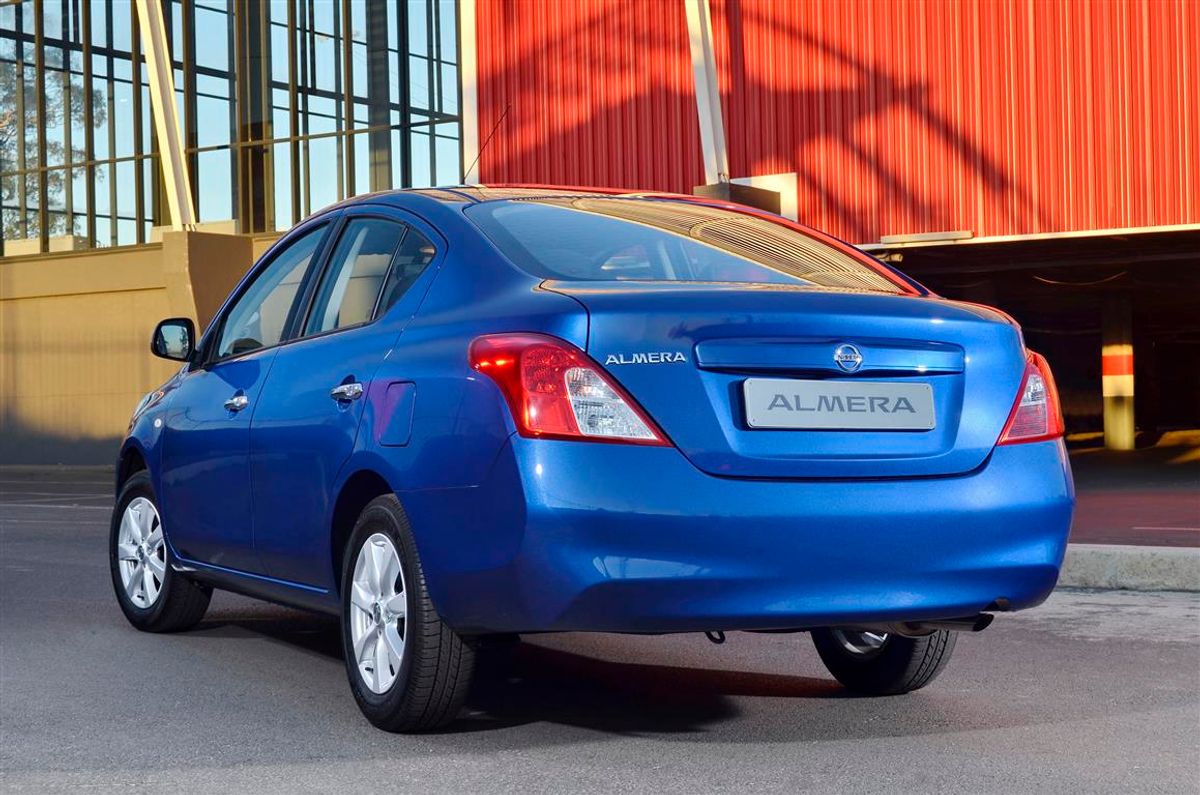
Enter the Nissan Almera, a nameplate South Africans will remember from the early 2000s. Based on the Micra, the Almera can be thought of crudely as a Micra with a boot, but some clever engineering means it offers a lot more than its hatchback sibling.
Space, space and more space
It’s difficult to describe how much interior space is available, particularly in the back and in the boot. Two 6-footers could easily sit behind each other (one in the driver’s seat, one behind). If you’re a freakishly tall family on a budget, this is the car for you. I’ve driven very large German saloons that don’t offer half the rear legroom of the Almera.
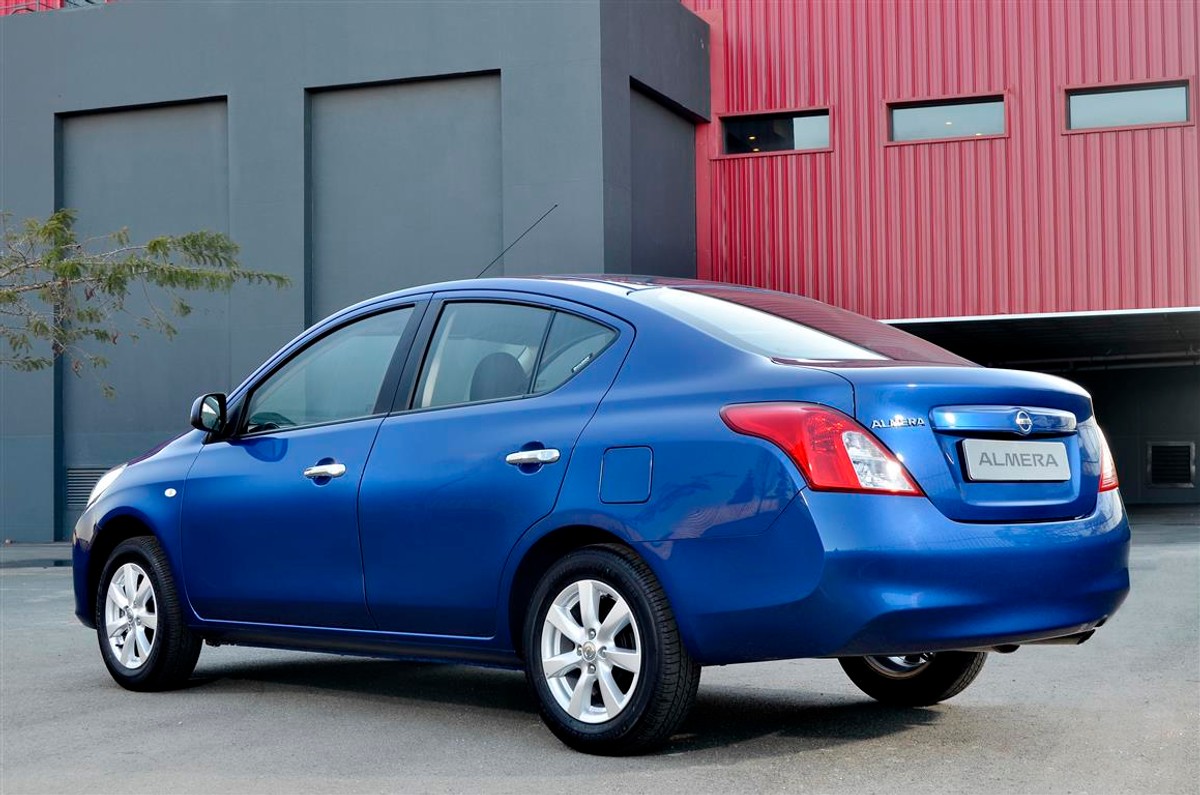
The boot space is equally cavernous, at 490 litres, and much emphasis has been placed on smoothing out the edges of the boot to create as much usable space as possible. I’m not sure how else to describe how big 490 litres really is – I can comfortably climb in there if that helps.
As a family vehicle for saleat Group 1 Nissan, I would argue this is about as practical as it’s going to get at this price point.
Comfort, Interior design and features
The Almera will be offered in one trim level – Acenta. This means pretty much everything you could want in a budget ride is standard, which makes things nice and easy – no sifting through a long options list. More on that at the end of the article.
Most of the interior bits and pieces have been lifted from the Micra, which is not a bad thing overall. The climate switchgear still feels too plasticky, but otherwise, the interior feels durable and well put together. At this price point, it’s about as good as it’s going to get.
I did like the addition of an independent rear fan. This will certainly be welcome in summer. It hasn’t really been warm enough to test it in Cape Town, but it has two speeds and works by sucking in air-conditioned air from the front area and pushing it through to the rear.
Where Nissan has excelled is drive refinement. The engine is incredibly quiet at idle, and cabin noise is very decent while on the move. In fact, with the radio on the sort of sensible volume my Gran would appreciate, there’s barely any road noise at all at urban speeds.
I still think the seats could offer more lateral support, but besides that, they are comfortable and the driver’s seat adjusts for height.
The pedals, gear shift and steering are all successfully engineered to be incredibly light and undemanding – it’s not a taxing drive at all. A decade or two ago, a car in this price bracket would have been a bit of a pig to drive. Not anymore.
If you’re looking for the kind of drive that gets your senses tingling, you’re not looking at an Almera anyway, and Nissan knows that.
New Nissan Almera Styling
I’m not mad about the styling, mostly because it looks like I designed it. And the height of my car design career was in the back of Maths in Standard 3. In this segment, I don’t think car makers can afford to ignore styling especially with the Koreans and French making some striking yet affordable cars at the moment.
That said, it’s not offensive and will appeal to a very wide audience. I could live with it, and my Gran loves it. Chalk that up to success then.
Engine and drive
The Almera will only be available with one engine, the 1.5 litre inline-4 petrol, which has been tried and tested in the Micra. It’s a decent little workhorse; it has enough power to make it feel useful when nipping through traffic, and cruising at motorway speeds is no problem.
It doesn’t like revving near the red line, but most of these small-displacement engines don’t. Again, if you’re a red line junky, you’re probably not looking at an Almera anyway. Below 4000rpm, the engine offers everything you need in a package like this.
Claimed consumption is fair, at 6.3 litres/100km. My test unit is averaging 7.2, but that has been exclusively short trips in town. With some highway driving, I’m sure that figure will drop. Claimed consumption for the auto box is higher at 7.2 litres/100km; bear that in mind when making up your mind about the transmission. If you sit in traffic, an auto does make life less stressful.
Safety features
Driver and passenger airbags are standard, as well as a suite of braking assist functions, ABS, EBD and BAS. The passenger cell features high strength construction, ISOFIX anchor points are standard as well as an immobiliser.
Standard features on the New Nissan Almera
The Almera is available in 6 colours with full-colour coding (bumpers and wing mirrors).
Standard features include:
– 15-inch alloy wheels, – electric door mirrors, – manual air conditioning with dedicated rear vents and independent fan speed – control, – a radio/CD/MP3 audio system with aux input port, – steering wheel audio controls, – a height-adjustable driver’s seat, – tilt adjustment for the steering wheel, – remote central locking with speed-sensitive auto-locking doors and – a comprehensive trip computer with two trip meters, instant and average fuel economy readouts, tank range and service information.
Summary
Nissan has gone for a value package here and succeeded in offering something that South African’s certainly appreciate: space. It’s a car that is about the size of vehicles in the segment above, at a B-segment price. It’s not the most exciting car in the world but practicality and budget are not exciting concepts, to begin with.
Nissan Almera in South Africa
*The all-new Nissan ALMERA rangeis available as standard with a 3-year/60 000 km service plan and Nissan’s 3-year/ 100 000 km warranty. Service intervals are 15 000 km.
Firm’s best-selling pick-up given more ‘car-like’ driving dynamics and increased payload
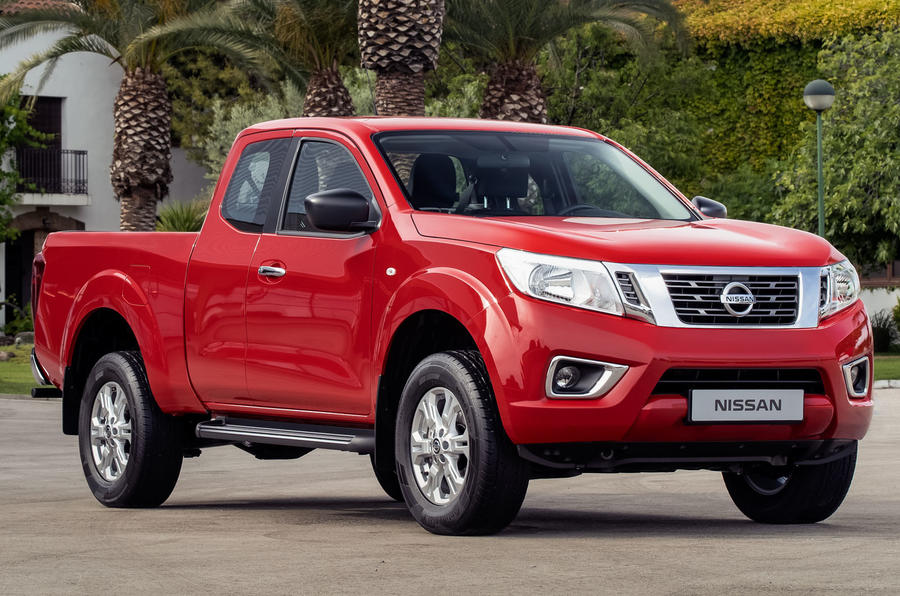
Nissan has updated Navara pick-up for 2020, with increased connectivity and a new six-speed gearbox among the chief changes.
On sale from 1 July in the UK, the refreshed Navara range is available at Group 1 Nissan in the entry-level King Chassis Cab Visia or the Double Cab N-Guard with an optional seven-speed automatic gearbox.
Multi-link rear suspension, previously equipped on top-spec models, is now fitted as standard to all variants, raising the pick-up’s rear by 25mm and increasing the payload capacity by up to 46kg. Nissan also says the suspension revisions promote a more “comfortable and dynamic ‘car-like’ driving feel”.
The Navara’s entry-level 2.3-litre diesel engine has been given a second turbocharger, taking total power output from 158bhp to 161bhp, and good for a torque figure of 313lb ft. The engine now conforms to impending Euro 6d-temp emissions regulations, which will apply to all new cars registered in Europe from 1 September 2019.
The Nissan Navara’s six-speed manual gearbox now features longer gear ratios and a shorter shift pattern, allowing for quicker changes and enhanced efficiency.
Nissan has also upgraded the Navara’s brakes, claiming that 4mm larger front brake discs and bigger brake boosters have increased braking force by 40% and reduced the model’s overall stopping distance.
Styling has been largely unchanged, but the addition of new 17in and 18in alloy wheel designs to the range, alongside new black headlight trim, sets the model apart from pre-facelift examples.
Changes inside are subtle, but fitted as standard from mid-range N-Connecta trim upwards is Nissan’s latest connectivity system, an 8in touchscreen, Apple CarPlay, and the ability to lock/unlock the Navara, configure the sat-nav and check fluid levels via an associated smartphone app.
The Navara was Nissan’s best-selling pick up in 2018, with 231,435 units sold worldwide – a 6% increase on 2017’s sales figures.
The Nissan Micra has gained a couple of new petrol engines — will they help the supermini compete with its rivals?Let’s find out…
WHAT IS IT?
Nissan’s keen to point out that it’s listened to customer feedback on the latest Micra. Although the car’s only been out for two years, drivers criticised the engines, calling them underpowered and bemoaning the lack of an automatic gearbox.
So, this early-life upgrade addresses those points and gives the popular supermini a new edge — essential in such a crowded marketplace where bestsellers such as the Ford Focus and Volkswagen Polo, dominate.
WHAT’S NEW?
This isn’t a facelift, and so 2019 Micras don’t look any different to their predecessors on the outside.
The changes come under the bonnet, where Nissan has fitted a pair of new 1.0-litre turbocharged petrol engines to replace the ageing — and not particularly good — 0.9-litre unit.
They offer 99bhp and 116bhp, and the former can be mated to an automatic gearbox, which is a first on this generation of Micra.
Nissan’s also introduced a new ‘sporty’ trim level. Called N-Sport, it’s available exclusively with the higher-powered engine and aims to take the fight to the Ford Fiesta ST-Line and Volkswagen Polo R-Line.
There’s also a new NissanConnect infotainment system — a vital upgrade.
WHAT’S UNDER THE BONNET?
The Micra still offers the basic 1.0-litre non-turbocharged petrol engine and 1.5-litre diesel engines as before, but the big talk is on the two new 1.0-litre turbos.
The higher-powered unit is fitted with the Micra’s first six-speed manual gearbox, and offers comparable performance to most of its main rivals. However, for all Nissan’s claims of it being a “warm hatch”, the tinny sound, rubbery gearbox and reluctant power delivery mean it’s far from a thrill.
Far more pleasant is the new 99bhp unit, which revs cleanly, albeit with an alarming turbine-style whirr. It can be had with an adequate five-speed manual or a CVT automatic. Surprisingly, we’d actually recommend choosing the automatic — it’s one of the best of its breed, and manages to resist the urge to send the revs spiralling at the merest mention of throttle input.
WHAT’S IT LIKE TO DRIVE?
The higher-powered engine comes complete with 17-inch alloy wheels, a quicker steering rack and lowered sports suspension. It makes the Micra more agile than the likes of the VW Polo, and it’s certainly easy to fling about city streets. It can’t hold a candle to the Ford Fiesta on the handling front, however.
Lower-powered models with the standard suspension do tend to lean through the bends, but the payoff is a very forgiving ride — the Micra is one comfortable supermini. We weren’t able to test the limits of its ability too much on our soaking-wet Portuguese test route, but the levels of grip and response from the steering were easily up there with the rest of its competitors.
HOW DOES IT LOOK?
There’s little news on this front — the only exterior changes for the 2019 Micra are some new trim combinations and the addition of LED front fog lights on certain grades.
N-Sport models lower the ride and add niceties, such as 17-inch alloy wheels, a chrome exhaust tip and N-Sport badging — but the makeover is far milder than that of a Fiesta ST-Line.
Overall though, the Micra remains a fairly handsome and sharply styled supermini — and it remains one of the most personalisable on the market, with customers able to choose trim finishes for various exterior elements including the wheels, mirror caps, and side mouldings.
WHAT’S IT LIKE INSIDE?
The Micra’s interior is generally one of the car’s strong points. Although space inside is only really average for the class, the sharply designed dashboard and lashings of interesting material choices — plus the sheer level of personalisation on offer — ensure there’s something to appeal to almost everyone.
WHAT’S THE SPEC LIKE?
The new N-Sport trim is based on the mid-spec Acenta, so rather than dazzling with lots of equipment, it offers a sporty look and mid-range specification. Still, sports seats, keyless entry, fog lights, carbon-fibre finishes for the door mirrors and alloy wheels plus rear privacy glass add to an already generous roster of climate control, cruise control, all-round electric windows, and the aforementioned NissanConnect system.
Automatic emergency braking and lane-departure warning are standard across the range, as are automatic headlights.
VERDICT
These new engines are a vast improvement over the old 0.9-litre, and definitely make the Micra worth further consideration. In fact, this updated model feels like the car that the Micra should have been at launch.
It’s some way off the class best when it comes to driving dynamics, but now offers the same excellent economy, good levels of equipment and sharp looks as it did before, just without the poor engine to hold it back. The Xtronic automatic, meanwhile, could be one of the best non-electric city cars you can buy. Find the right Micra for you at Group 1 Nissan today.
This is the latest in a long line of Nissan pick-ups, from a family tree that stretches back 80 years. Things move quickly in the motoring world though, and a class-leading vehicle can soon find itself an also-ran in just a few short months.
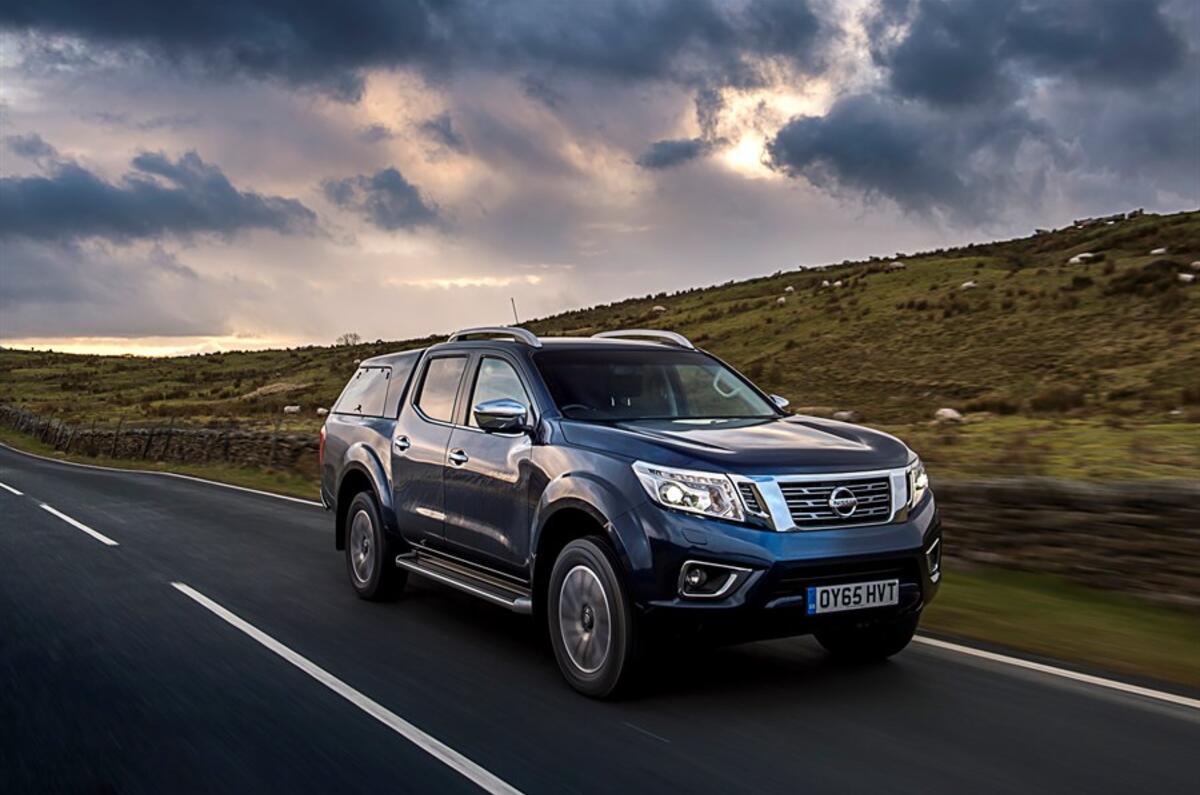
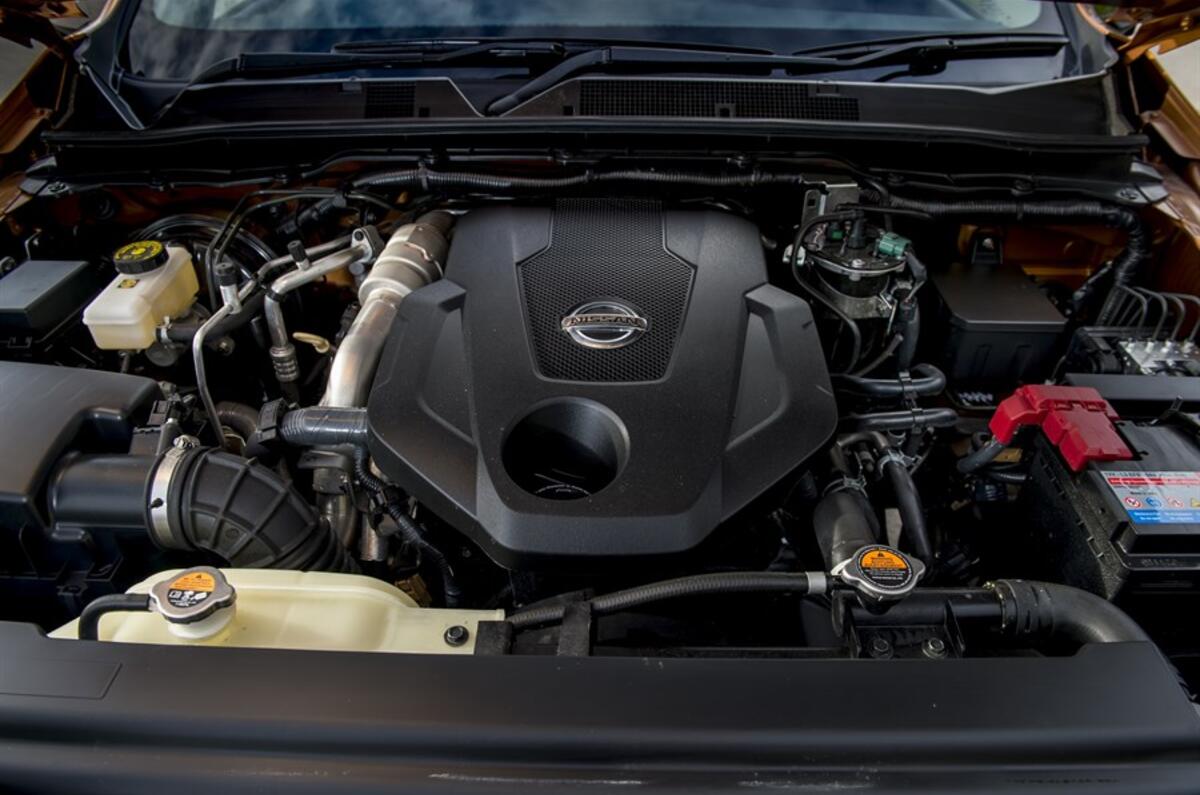
Ten years is therefore the motoring equivalent of an age, but despite this, that’s exactly how long the second generation of Nissan Navara had been on sale in the UK. As good as it was, time waits for no man (or 4×4). So with impeccable timing, Nissan has brought its third-generation Navara, the Nissan NP300 to the forefront. Considering that there are refreshed versions of the Ford Ranger, Toyota Hilux, Volkswagen Amarok and Mitsubishi L200 all entering the market, the Nissan has some stiff competition. However, this fight for supremacy is only set to intensify with the Renault Alaskan (based on the Navara) and Fiat’s Fullback (based on the L200) both priming themselves to enter the battle, while Mercedes-Benz, Peugeot and Citroën are all watching on from the horizon. Therefore it’s a good thing that Nissan has been thorough with the NP300, then. Although the chassis and 4WD system are modified versions of those found on the second-generation Navara, everything else is new. The engine has predictably been downsized and now comes in at 2.3 litres, a reduction of around 200cc.
Two outputs are available: 158bhp and 187bhp. You might expect Nissan to have simply cranked the boost up to get the additional power, but they’ve been a little more thorough than that, bolting on an extra turbo to create extra grunt. Naturally, both engines feature economy and emissions improvements, too.
The big news is that the Double Cab ditches the old-school leaf sprung rear end of the previous generation. In its place is an all-new five-link set-up with coil springs that promises greater ride comfort and improved handling. Despite this change, it can still carry over a tonne in the bed and tow 3.5 tonnes.
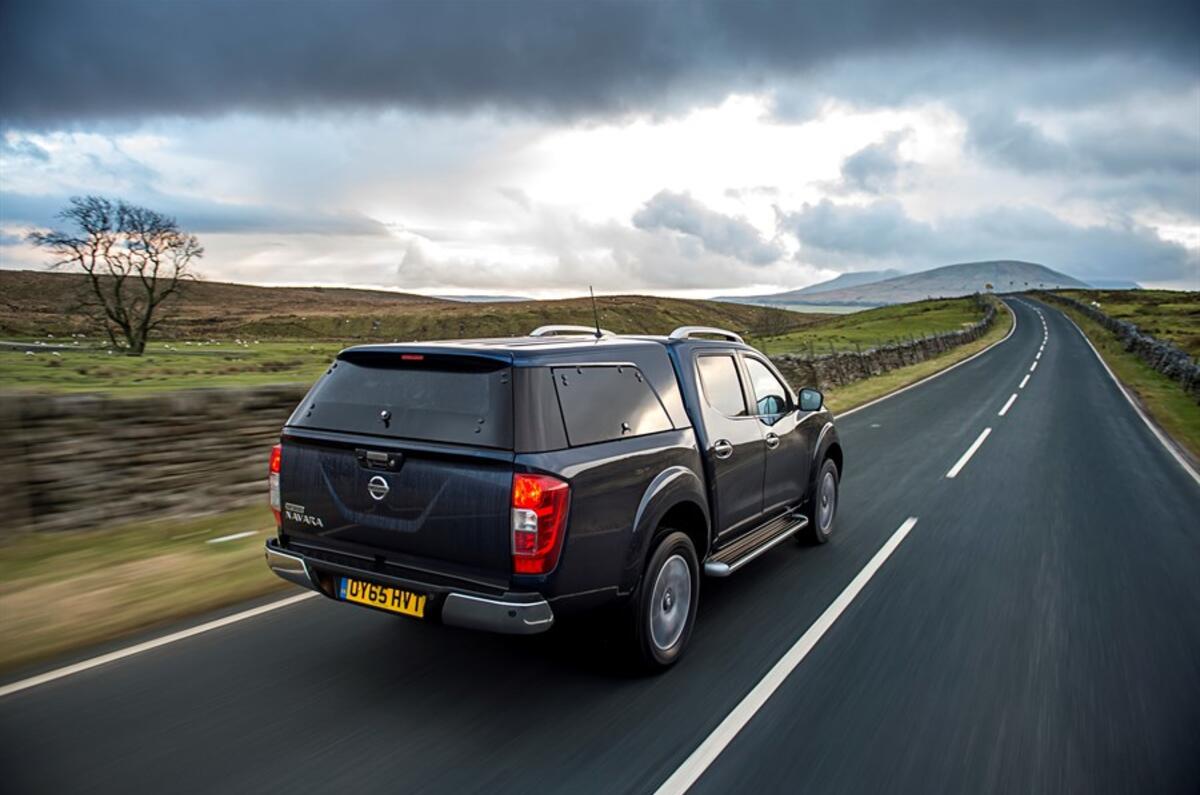
While King-Cab models still soldier on with cart springs, these will account for less than 10% of projected sales and are likely to be bought purely as workhorses. As the Double Cab is the one that will appeal to private buyers, potentially as an alternative to an SUV, that’s the model we’re looking at here.
We’re not going to beat around the bush, the NP300 has the best ride comfort of any unladen pick-up we’ve experienced, although the latest generation Toyota Hilux has run it close. Where the previous-generation Navara (and other leaf-sprung competitors) would become bouncy and unsettled, the new model feels much more like a conventional SUV.
Even over sizeable bumps the rear end soaked up the initial hit before settling back down again almost immediately. Any pogo action you might have expected is notable only by its absence, which makes for much more comfortable progress over a variety of surfaces.
Handling is also much improved. You can carry a surprising amount of speed around bends while even rapid direction changes are completed without fuss. You’d never call it fun – slow steering and the laws of physics see to that – but it really does feel like a very stable vehicle and much better than you’d expect from a pick-up.
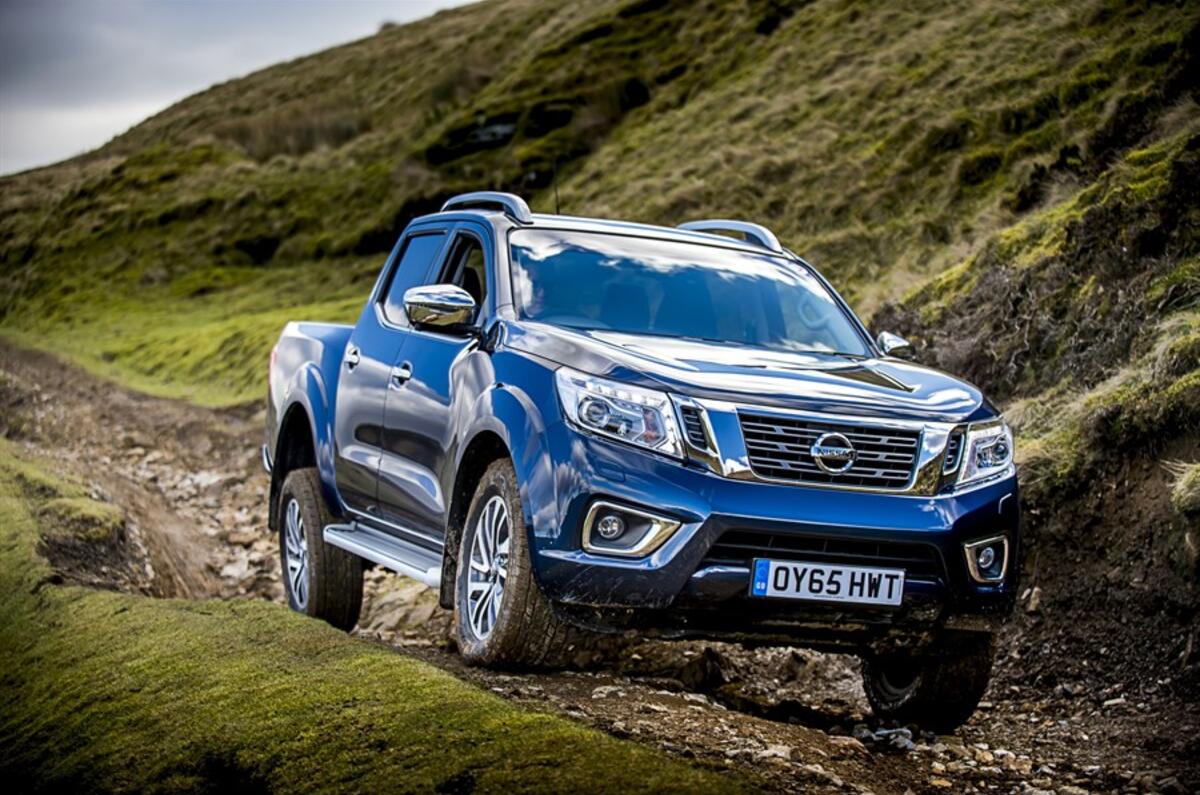
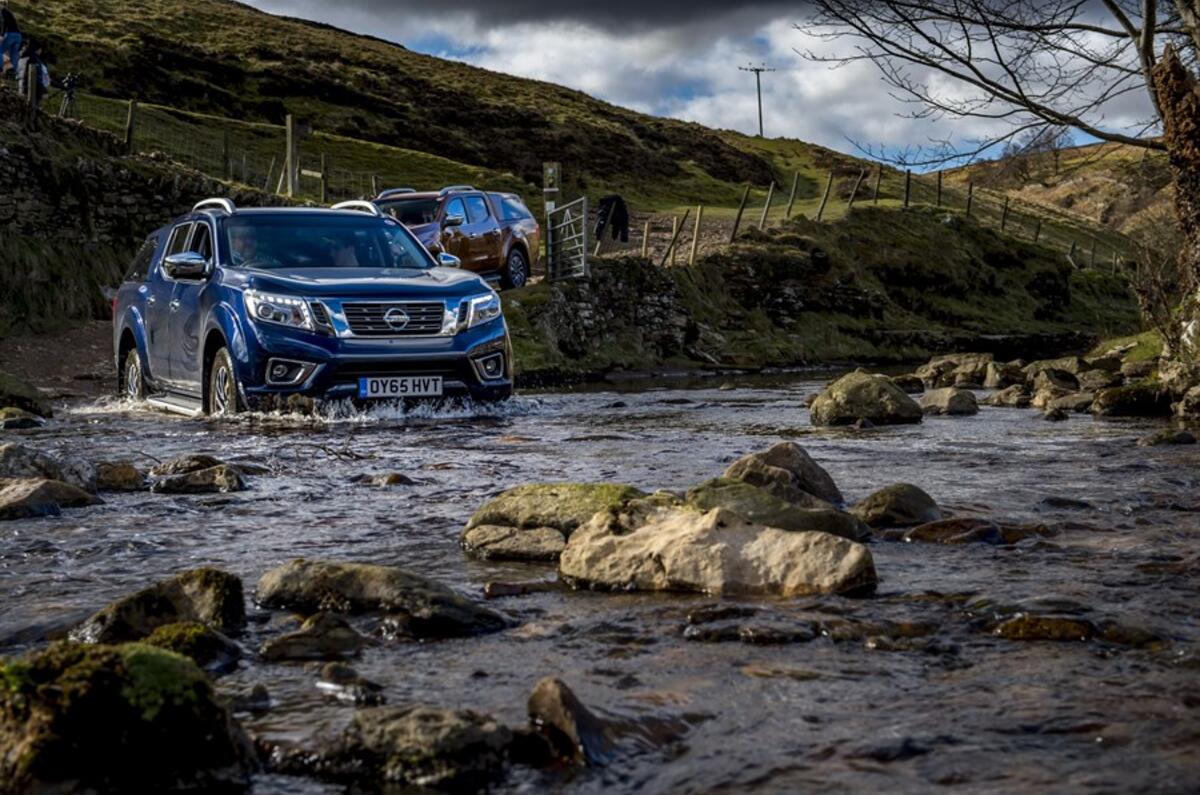
Despite this, the NP300 is still more than capable off-road. The Double Cab is 4WD only and comes complete with a low range ’box, hill descent control and excellent axle articulation. If you want to get really serious, a rear diff-lock is on the options list, too. Up a steep and rocky trail, the Navara didn’t even break into a sweat.
While it is a significant step forward over the old model, there are still reminders that the Navara is, in essence, a working vehicle. The rear suspension is a massive improvement, but there’s no getting away from the fact there’s a heavy-duty live axle attached to a ladder frame chassis.
Go over a vicious bump on one side and you can feel the rear wheels are connected, and you do get the odd shimmy from the body. Ultimately, a conventional SUV with a monocoque structure and less unsprung weight will ride and handle better. It wouldn’t be able to carry over a tonne in the back, though.
Nissan is claiming the interior has been inspired by its crossovers. At first glance, our top-spec Tekna test model appears similar to a Qashqai or X-Trail, there are four other trims to choose from including the entry-level Visia, Acenta, Acenta + and N-Connecta. There’s attractive piano black trim, a sprinkling of metal effect detailing plus a touchscreen infotainment system with navigation and around-view monitor – particularly handy on something this big.
The entry-level Visia models come equipped with steel wheels, air conditioning and a six-way manually adjustable driver’s seat, while upgrading to Acenta gets you alloy wheels, a range of chrome details, and keyless entry and go. Acenta+ models get 18in alloys, side steps, dual-zone climate control, a reversing camera, and heated, electrically folding mirrors included in the package, while the N-Connecta trim gains a 7.0in touchscreen Nissan Connect infotainment system with sat nav, DAB , Bluetooth streaming capability and smartphone integration.
The range-topping Tekna spec gets most in the way of luxury appeal in the shape of roof rails, LED headlights, front heated seats, leather upholstery, rear parking sensors, a 360-degree camera and electrically adjustable driver’s seat.
Further inspection reveals that although it looks crossover-like, it’s still a commercial vehicle at heart. The leather steering wheel and gear lever are nice enough, but those expecting a sea of soft-touch plastics should look elsewhere. Everything is solid and will no doubt be tough as old boots, but the plastics are all hard to the touch.
This workmanlike quality extends to the engine. You are always aware that there’s a fairly big diesel mill up front, and it gets particularly thrashy above 3000rpm. Performance is respectable with either engine output – it’s no ball of fire, but it’s always able to keep pace with traffic.
Given the choice, we’d opt for the 187bhp unit simply because you don’t have to work it quite as hard. From a driving perspective, we’d also be tempted by the automatic gearbox; it can be a little sluggish from a standing start and the odd shift could be smoother, but it’s better than the long-throw and occasionally vague manual ’box.
Wearing our sensible trousers, it’s worth knowing that the seven-speed automatic does increase CO2 levels from 169g/km to 183g/km, while economy tumbles from 44.1mpg to 40.3mpg. It should also be noted that the 187bhp lump is the only option should you want an auto or one of the top tier trim levels.
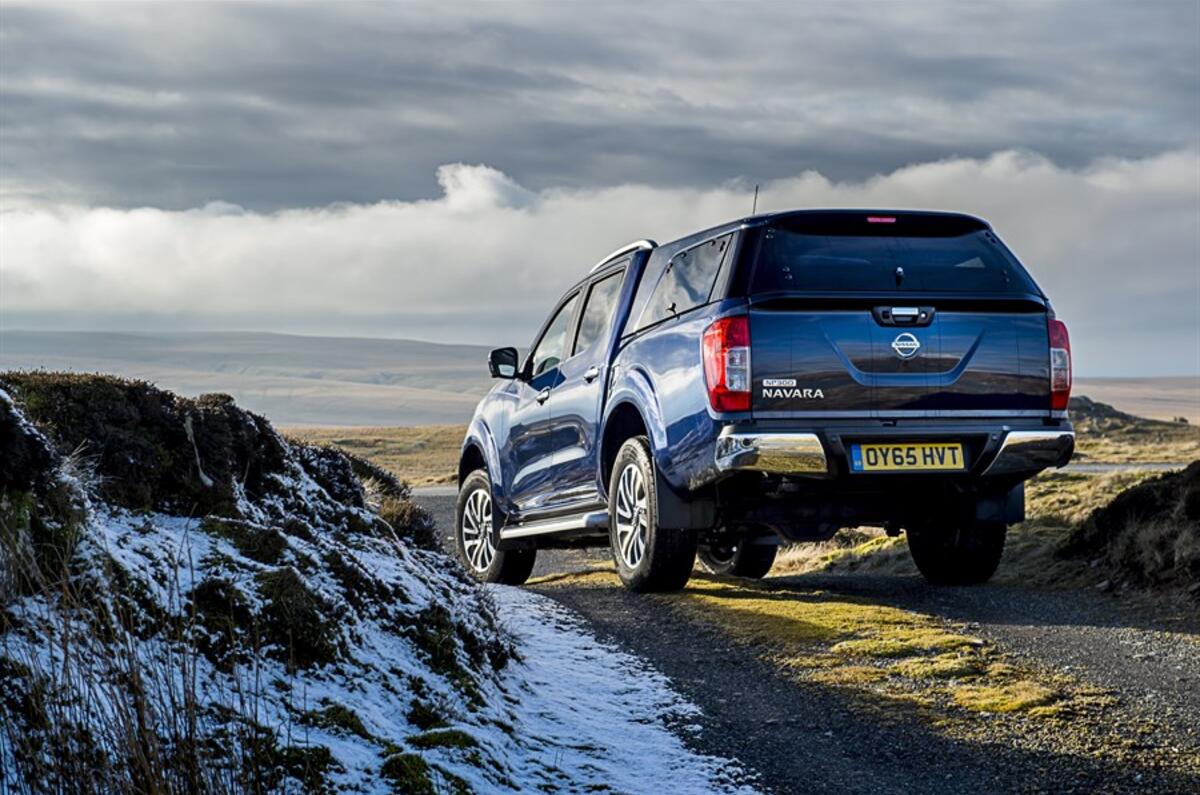
The Navara is far more comfortable than its competition, looks good in the metal (to these eyes at least) and yet is still able to carry or tow big loads, therefore if you are in the market for a pick-up it is the one to go for. But is it a direct competitor to an SUV? That’s a tricky question to answer.
There’s no doubt an SUV would offer cheaper running costs, better rear seat accommodation, should handle even better and probably have a higher level of perceived quality inside.
Not that this will matter that much to many people who are likely to buy a Navara, though; the idea of a do-everything lifestyle vehicle is the appeal here. That the Nissan doesn’t drive exactly like a crossover is no real issue; by narrowing the gap between pick-up and SUV, the NP300 has become one of the best pick-ups out there – book a NP300 test drive at Group 1 Nissan.






 The Nissan Fan